Fleet insurance
Multi-Vehicle Insurance for Business
Insuring a work car and van, or a few business vehicles, without taking on a full fleet policy. One enquiry reaches brokers who discuss the options and provide quotes.
- Business vehicles only, not household cars
- Cars and vans with different classes of use
- A route between single policies and a fleet
Partnered with Quotezone
What being partnered with Quotezone means FleetQuote is a trading name of Simply Quote Comparison Ltd. Enquiries are passed to Quotezone, a trading style of Seopa Ltd (FCA FRN: 313860), which operates the quote panel. Simply Quote Comparison Ltd is an Introducer Appointed Representative of Seopa Ltd (FCA reference: 1011184), so we may be paid a commission if your enquiry leads to a policy. We do not give advice or make recommendations. Your choice of provider is entirely your own.FleetQuote is a quotation service, not an insurer or broker.
Last reviewed 17 September 2026
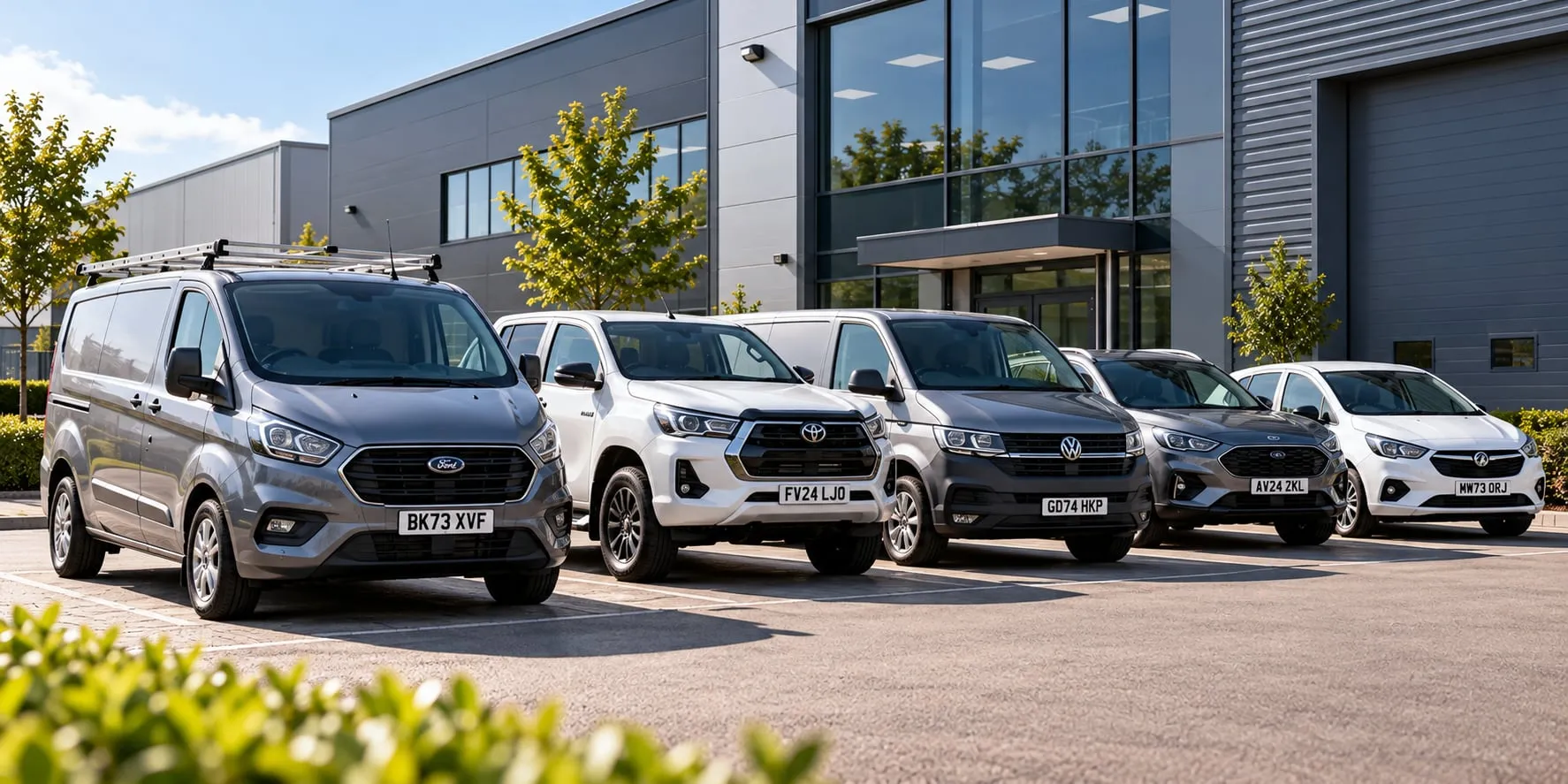
Fleet insurance quotes from the providers on our partner panel, including
















Three things that decide which multi-vehicle route fits
Most businesses can place themselves quickly using these questions.
-
Who owns the vehicles
Vehicles owned, leased or hired by the business are in scope. Employees' own cars and family runabouts are not.
-
How often drivers swap
If each vehicle has one regular driver, a simpler arrangement may do. Shared vehicles point towards fleet-style driver rules.
-
How fast you are growing
A business adding vehicles every few months usually benefits from a policy built for mid-term changes.
Overview
Multi-vehicle insurance
Multi-vehicle insurance, in a business context, means covering two or more work vehicles together with one provider. The request that comes up most is a car and a van: a director’s car plus the van that does the jobs, or a sales car alongside a delivery van.
The term is slippery, because it is attached to several different products, including household multi-car policies that have nothing to do with business use. This page separates those meanings, shows how a business car and van arrangement usually works, and marks the point where a small fleet policy becomes the better answer.
FleetQuote deals with business vehicles only.
In short
For a business, multi-vehicle insurance means insuring two or more work vehicles, often a car and a van, under one arrangement with a single provider. It is different from household multi-car cover, which is for private cars. Depending on the insurer, it may keep each vehicle separately rated or work more like a small fleet policy, so check which one you are being offered.
At a glance
- Who it is for
- Businesses insuring two or more vehicles they own, lease or hire
- Not for
- Household private cars or employees' own vehicles
- Common mix
- A company car alongside one or more vans
- Pricing approach
- Varies; often per vehicle, sometimes fleet-style
- Car licence limit
- Category B covers vehicles up to 3,500kg MAM with no more than 8 passenger seats
- Who provides quotes
- A specialist broker, not FleetQuote
01
What Does Multi-Vehicle Insurance Mean For A Business?
It means two or more vehicles the business owns, leases or hires, held with one provider. Whether those vehicles are still priced one by one or rated together as a group depends entirely on which product you are being offered.
The three things the label can mean
- Household multi-car cover. A personal product for private cars at one address, usually with each car priced on its own and sometimes a reduction for holding several together. It is not built for vans, business mileage or employees.
- Business multi-vehicle arrangements. Two or more work vehicles held with one insurer, sometimes as separate policies under one account and sometimes on a single policy. Each vehicle is often still rated on its own merits.
- Small fleet policies sold under another name. Some providers label their small fleet product as multi-vehicle cover. These normally run one schedule, shared driver rules and pricing that looks at the business as a whole.
Questions that cut through the label
The structure matters more than the name on the quote. Ask whether vehicles are priced individually or together, whether the renewal dates line up, and how driver permissions are set.
Ask also what happens when a vehicle joins or leaves. The answer tells you quickly whether you are looking at an account of separate policies or a single schedule.
02
Is Business Multi-Vehicle Cover The Same As Multi-Car Insurance?
No. Household multi-car policies are designed for private cars kept at one address and driven by family members, while business cover is for vehicles the business owns, leases or hires and uses for work.
Why household cover does not stretch to work vehicles
Putting a work van on a household policy, or relying on private cover for business driving, can leave the vehicle uninsured for the way it is actually used. The gap tends to appear at the point of a claim rather than at the point of sale.
Business mileage, employees as drivers and goods carried for the firm are all outside what a household product expects. Each of those is normal on a business arrangement.
What FleetQuote handles
FleetQuote passes on enquiries about business vehicles only, and does not deal with household multi-car insurance. Several private cars in one household belong with a personal motor insurer or broker instead.
Where some vehicles are business vehicles and some are genuinely private, say so at the enquiry stage. The broker can then explain which of them can sit on business cover and which cannot.
03
Which Businesses Does This Route Suit?
A business with a small, settled set of vehicles, each with a clear purpose and a regular driver. A surveyor with a company car and a site van, a caterer with an estate car and a refrigerated van, or a two-partner firm with one vehicle each.
Settled vehicles, settled drivers
The route works least well where people swap vehicles week to week. Per-vehicle driver rules start to feel like paperwork once three or four people share two or three vehicles.
It works best where the pattern is stable enough to write down and leave alone for a year. That is also the pattern insurers price most comfortably.
How many vehicles are involved
The market does not use one definition. As general practice, fleet and small fleet products begin at two or three vehicles, and small fleet products often cap out somewhere around 12 to 20.
Multi-vehicle arrangements tend to sit at the lower end of that range, which is why the choice between them and a mini fleet policy usually comes up at three or four vehicles. Our guide on how many vehicles you need for fleet insurance looks at the thresholds themselves.
04
How Does Insuring A Car And A Van Together Work?
It works once each vehicle is described separately: its own class of use, its own permitted drivers and its own cover level, all under one arrangement. Pairing a car with a van raises questions that single-type policies never have to answer.
Two classes of use on one arrangement
The car may need business use plus social, domestic and pleasure if the director drives it at weekends. The van may need carriage of own goods, or hire and reward where it delivers other people’s goods for payment.
Each vehicle should carry the class that matches its own work rather than the firm’s main activity. Our guide to vehicle class of use explains what each class allows.
Two sets of drivers
It is common for the car to be driven by one or two named people and the van by a wider group. Some arrangements let you set driver rules per vehicle, which fits that split neatly.
Where the van group keeps changing, a policy with shared driver rules is less work. Our page on multi-van insurance covers that side in more detail.
Lining up renewal dates
Where the car and van were insured at different times, bringing them together usually means aligning renewal dates. Cancelling an existing policy early can involve a charge, so plan the timing before anything is cancelled.
Our guide on moving to a fleet policy runs through the switching steps in order. Doing it at a natural renewal date avoids most of the cost.
Account terms
Some insurers offer different terms where more than one vehicle is held with them. That is not guaranteed, and it depends on the vehicles and drivers involved rather than on the vehicle count alone.
05
Which Route Should You Ask A Broker About?
Match the route to how settled your drivers are and how fast the vehicle count is moving. The table below is a starting point for that conversation, not a rule.
Four routes compared
| Route | Usually suits | Driver set-up | Main trade-off |
|---|---|---|---|
| Individual policies | One or two vehicles, each with one regular driver | Set per policy | Separate renewals and paperwork |
| Business multi-vehicle | A car and van or a few vehicles with settled drivers | Often per vehicle | Less flexible when drivers swap |
| Mini fleet | Roughly 3 to 10 vehicles, some shared driving | Named or any authorised driver | First-year terms may depend on individual histories |
| Fleet | Larger or fast-changing fleets | Policy-wide rules | More weight on the business’s claims record |
Allow for next year, not just this one
If you already know vehicles are being added in the next twelve months, raise it at the first conversation. A route that suits two vehicles today can become awkward at five.
Our overview of fleet insurance describes how the larger products handle constant change. Our guide to what fleet insurance is covers the groundwork if the term is new to you.
06
What Is Covered, And Which Add-Ons Matter?
Cover follows the usual pattern of third party only, third party fire and theft and comprehensive cover, and you can often pick a different level for each vehicle. The add-ons that earn their place are the ones that keep a working vehicle on the road.
Cover levels per vehicle
A newer company car may justify comprehensive cover while an older van runs on third party fire and theft. Mixing levels across two or three vehicles is normal on this kind of arrangement.
Vehicle value is the usual deciding factor. The question to answer is what the business would do if a vehicle were written off tomorrow.
The extras for a car and van mix
- Courtesy vehicle. A small hatchback is little use while the van is off the road, so check what size of replacement is offered.
- Legal expenses. Helps recover uninsured losses after an accident that was not your fault.
- Breakdown and recovery. Matters most for a van that has to reach jobs at a set time.
- Tools or goods in transit. Usually sits outside the motor cover on the van.
- Windscreen cover. Often part of comprehensive cover, sometimes an extra.
- European use. Worth confirming if either vehicle travels abroad.
Which of these come as standard varies by insurer and by policy. Ask for the list against each option, because two quotes at the same level can contain different things.
07
Do You Keep The No Claims Discount On Each Vehicle?
It depends on how the arrangement is built. Where each vehicle stays individually rated its own discount may keep counting, while a fleet-style policy tends to look at the combined claims record of the business instead.
Individually rated arrangements
Discount earned on a vehicle can often carry on where that vehicle is still priced on its own. Keep the renewal notice that shows the number of years, because that document is the evidence.
Fleet-style arrangements
On a policy that works like a fleet, years of discount on one van matter less than the pattern of claims across the business. The effect is not always negative, but it is different.
Ask how discount already earned will be treated before cancelling anything. A discount surrendered by accident is hard to recover.
08
What Do Insurers Look At On A Multi-Vehicle Arrangement?
Each vehicle and each driver rather than the business as a single risk, because vehicles on these arrangements are so often priced one at a time.
Each vehicle
- the make, model, value and any modifications
- class of use and estimated annual mileage
- where it is kept overnight
- the no claims discount and claims history attached to it
Each driver and the business
- who drives which vehicle, with dates of birth, licence details, points and claims
- the nature of the business and how long it has traded
- how vehicles are allocated and who holds the keys
Two or three vehicles is a small enough number that one claim shows up clearly. That cuts both ways, because a clean record on a small arrangement is easy to demonstrate.
09
Who Is Allowed To Drive, And How Do You Check?
Only the people the arrangement covers for the vehicle in question. Permitting anyone else to drive is an offence in its own right, so the check belongs before the keys are handed over.
Permitting use
Under section 143 of the Road Traffic Act 1988, it is an offence not only to drive without insurance but to cause or permit someone else to use a vehicle without cover for that use. A business that hands a van key to someone outside the policy is exposed, even where that person is an employee.
Licence categories
A category B car licence covers vehicles up to 3,500kg maximum authorised mass with no more than 8 passenger seats, under the GOV.UK driving licence categories. Zero-emission vehicles can reach 4,250kg on the same category, under GOV.UK’s guidance on driving an electric or hydrogen-powered vehicle.
Most car and light van pairings sit well inside those figures. A large van with a heavy conversion, or a minibus, may not.
Running the check
A driver can generate a check code through GOV.UK’s view or share your driving licence information service. The code is valid for 21 days and can be used once, and you also need the last 8 characters of the licence number.
Getting someone’s driving information without their permission is a criminal offence. Ask for the code, keep a note of the date you checked, and repeat the check at a set interval.
10
Do Employees’ Own Cars Go On The Policy?
Not normally. A car owned privately by an employee needs business use added to that employee’s own motor policy, and those vehicles are known collectively as the grey fleet.
Grey fleet duties
HSE treats vehicles owned and driven by workers for business as grey fleet, and its guidance on driving and riding safely for work applies to them. Employers should satisfy themselves that these vehicles are insured, taxed and hold a valid MOT where one is needed.
Condition matters as much as paperwork. HSE’s guidance on maintaining vehicles covers the checks and servicing expected of vehicles used for work.
What to keep on file
Our grey fleet guide sets out the records to hold and how often to refresh them. Mention regular use of staff cars when you enquire, because it changes what the business still needs to insure.
11
How Can You Influence The Terms You Are Offered?
By tightening the description of the risk rather than by chasing a promise of a lower price. Most of the detail that moves the terms is detail you control.
Checklist before you enquire
- Each vehicle has the class of use it really needs, and no more
- Occasional drivers are limited to the vehicle they actually use
- Proof of no claims discount is to hand for each vehicle
- Overnight parking is off-road wherever practical
- Voluntary excess is set at a level the business could pay
- Vehicles no longer used have been taken off cover rather than left on it
What varies between insurers
Annual payment, accurate mileage estimates and dashcams that help settle disputed claims are all worth raising. How much weight each one carries differs from insurer to insurer, so ask rather than assume.
12
When Is Multi-Vehicle Cover Not The Right Fit?
When the cars are really private, when staff drive their own, when drivers swap vehicles constantly, or when the vehicle count is climbing fast.
Six situations that point elsewhere
- The cars are private household cars. They belong on a personal multi-car or individual motor policy rather than business cover.
- Staff mostly drive their own cars for work. Those are grey fleet vehicles, and the task is checking their cover rather than insuring them.
- Drivers regularly swap vehicles. Per-vehicle driver rules become hard to manage, and shared driver rules are simpler.
- You run several vans. A product built around vans and multiple drivers, such as multi-van insurance, fits the work better.
- Vehicles carry other people’s goods or passengers for payment. Courier, taxi and minibus work needs the right hire and reward cover and often a specialist policy.
- The vehicle count is growing quickly. A fleet insurance policy is built for frequent additions and removals.
Where to look next
A heavier vehicle in the mix, such as a tipper or a tractor unit, points towards mixed fleet insurance instead. A broker can confirm which route your vehicles and drivers can actually be placed on, and FleetQuote passes the enquiry on without producing prices itself.
Before you enquire
What to have to hand
What you’ll need for a quote
You can start an enquiry without all of this. The broker will ask for anything missing.
- Number and types of vehicles (rough is fine to start)
- Renewal date and current policy schedule
- Claims experience letter from your current insurer
- Driver ages and any penalty points
- Where vehicles are kept overnight
Sources
Updates
- : last reviewed
General information about UK fleet insurance, not advice. How we write and check our content
Ready to get started?
Ready to talk to a fleet insurance specialist?
Answer a few questions about your vehicles, drivers and current cover. We pass your enquiry to a specialist broker, who will discuss your options and quotes with you.
FleetQuote is an introduction service, not an insurer or broker. We pass your enquiry to Quotezone, which operates a panel of brokers and insurers. How our service works
Questions
Multi-vehicle insurance: common questions
Can I insure a car and a van on one business policy?
Often, yes. Many insurers will accept a business car and a light van together, either on a multi-vehicle arrangement or a small fleet policy. Each vehicle still needs the right class of use, so the car might have business and personal use while the van has carriage of own goods. Give the broker a clear description of what each vehicle does and who drives it.
Is business multi-vehicle insurance the same as multi-car insurance?
No. Multi-car policies sold to households are designed for private cars kept at one address and driven by family members. Business multi-vehicle cover is for vehicles the business owns, leases or hires and uses for work. Putting a work van on a household policy, or relying on private cover for business driving, can leave you without cover for the way the vehicle is really used.
Does FleetQuote help with household multi-car insurance?
No. FleetQuote only passes on enquiries about business vehicles. If you want to insure several private cars in one household, a personal motor insurer or broker is the right place to go. If some of your vehicles are business vehicles and some are private, tell the broker so they can explain which vehicles can be included on business cover.
Will I keep my no claims discount on each vehicle?
It depends on how the arrangement is set up and on the insurer. Where each vehicle stays individually rated, its own no claims discount may continue to count. On a policy that works more like a fleet, the insurer may look at the combined claims record of the business instead. Ask the broker how discount already earned will be treated before cancelling anything.
How many vehicles do I need for multi-vehicle cover?
Two is usually the starting point, since the idea is to insure more than one vehicle together. There is no set upper limit that applies across the market, but once a business runs more than a handful of vehicles, or drivers regularly share them, a mini fleet or fleet policy is often the more practical option. The broker can tell you where your business sits.
Do employees who use their own cars for work go on the policy?
Not normally. Vehicles owned privately by employees usually need business use added to the employee's own personal policy. These vehicles are often called the grey fleet. Employers still have health and safety responsibilities for them, including checking the vehicle is insured, taxed and has a valid MOT where one is needed. Tell the broker if staff use their own cars regularly.
Related reading
- Cover Fleet insurance Fleet insurance for UK businesses running vans, cars, HGVs or mixed fleets. How fleet cover works, and an easy way to reach a specialist for quotes.
- Cover Mixed fleet insurance Mixed fleet insurance puts cars, vans, pickups, HGVs and minibuses on one policy. How uses, drivers and specialist vehicles are handled, and what to prepare.
- Cover Van fleet insurance Van fleet insurance explained for UK firms running two or more vans. Class of use, tools and goods cover, security, conversions and what insurers ask.
- Guide How many vehicles do you need for fleet insurance? There is no legal minimum fleet size. What insurers look for, how small fleets of two to four vehicles are treated, and when a fleet policy starts to make sense.
- Guide What is fleet insurance? What fleet insurance is, how a fleet policy works differently from insuring vehicles one by one, and the key terms UK businesses meet when they get cover.
What FleetQuote does, and doesn't do
FleetQuote is a trading name of Simply Quote Comparison Ltd (company number 15008284), registered office Sentinel House, Ancells Business Park, Harvest Crescent, Fleet, Hampshire, GU51 2UZ.
Simply Quote Comparison Ltd is an Introducer Appointed Representative of Seopa Ltd (Financial Conduct Authority reference 1011184). We are not authorised in our own right: we act under Seopa Ltd, which is authorised and regulated by the Financial Conduct Authority under reference 313860.
That permission covers introducing your enquiry and nothing more. We do not provide insurance, arrange insurance, recommend a policy or give advice.
When you send an enquiry we introduce you to Quotezone, a trading style of Seopa Ltd (FCA FRN 313860), which operates a panel of brokers and insurers. Any quote, advice or policy comes from them, not from FleetQuote.
Simply Quote Comparison Ltd is paid a commission when an enquiry leads to a policy, at no cost to you. It is free to enquire and you are under no obligation to buy.