Fleet insurance by industry
Fleet Insurance for Estate Agents
One policy for the branded cars and pool vehicles your branches share, plus a clear view of staff who drive their own cars to valuations. One enquiry reaches specialist brokers.
- Branded and liveried pool cars
- Negotiators, valuers and property managers
- Company cars alongside staff-owned vehicles
Partnered with Quotezone
What being partnered with Quotezone means FleetQuote is a trading name of Simply Quote Comparison Ltd. Enquiries are passed to Quotezone, a trading style of Seopa Ltd (FCA FRN: 313860), which operates the quote panel. Simply Quote Comparison Ltd is an Introducer Appointed Representative of Seopa Ltd (FCA reference: 1011184), so we may be paid a commission if your enquiry leads to a policy. We do not give advice or make recommendations. Your choice of provider is entirely your own.FleetQuote is a quotation service, not an insurer or broker.
Last reviewed 17 September 2026
Fleet insurance quotes from the providers on our partner panel, including
















Points underwriters raise with property businesses
An agency's cars are small and low-value, but they are driven by many people for many short trips.
-
Negotiator profile
Younger staff and trainees are common in agency, and driver age and experience weigh heavily.
-
Pool or allocated
Whether a car belongs to one valuer or is booked out by whoever has the next viewing.
-
Viewings and valuations
Frequent short journeys, unfamiliar addresses, tight streets and tricky parking.
-
Private use
Whether staff take cars home, use them at weekends or have them as a benefit.
-
Liveried vehicles
Wraps and signwriting that change the look and the repair cost of each car.
Overview
Estate agent fleet insurance
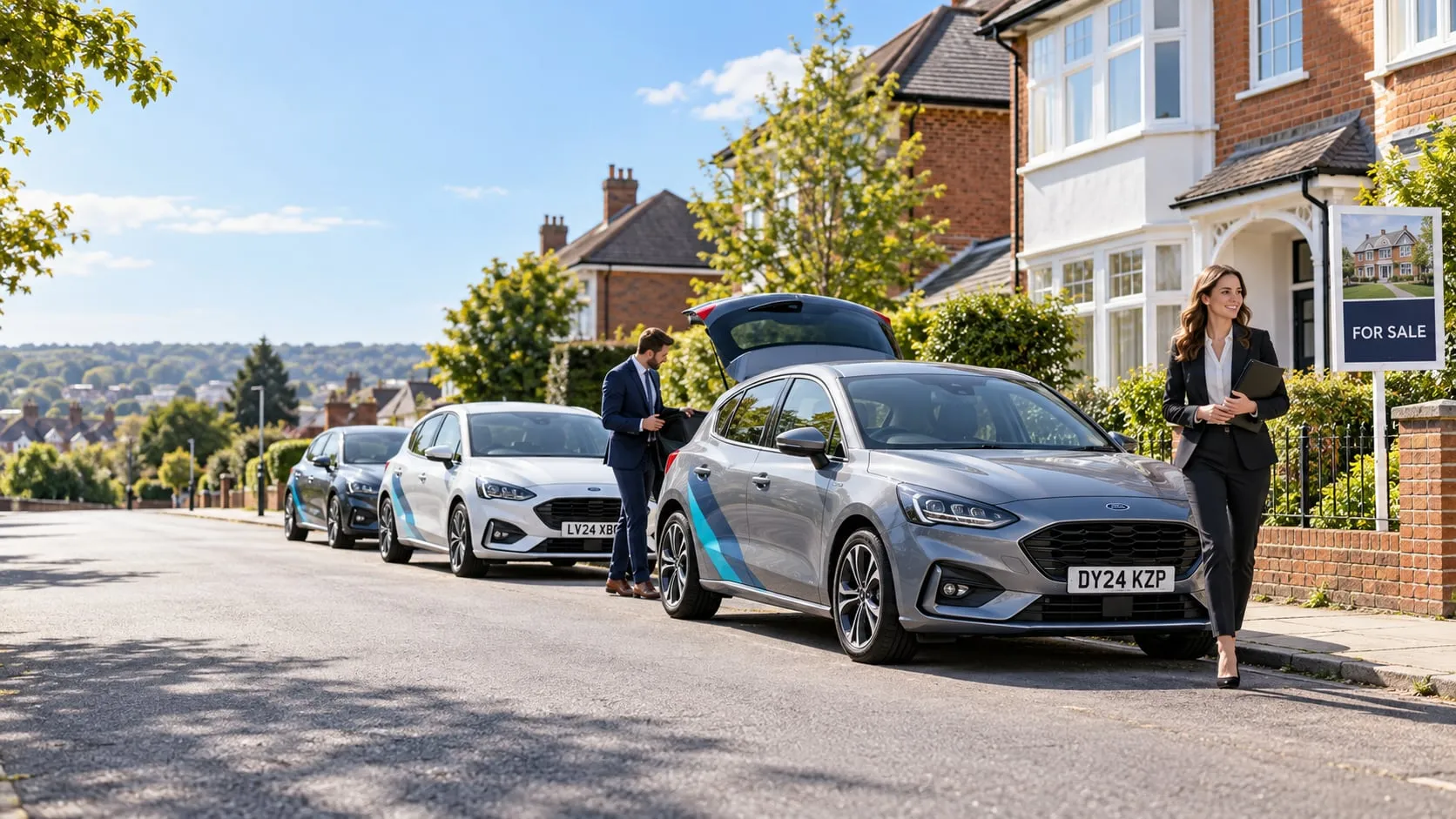
Estate agent fleet insurance covers the cars an agency runs for its staff. That means the small liveried hatchbacks parked outside branches, pool cars booked out for viewings, company cars for branch managers and valuers, and perhaps a van for a lettings maintenance team.
One policy covers the lot, so opening a new branch or handing back leased cars becomes a change to the schedule. Agencies have a distinctive driving profile that insurers recognise straight away.
The vehicles are rarely expensive, but they are driven by a wide range of people, many of them early in their careers. The journeys are short runs to addresses nobody in the car has visited before.
In short
Estate agent fleet insurance puts an agency's branded pool cars, company cars and any vans on one motor policy. Insurers look closely at driver ages, whether cars are shared or allocated, private use, carrying buyers to viewings and liveried bodywork. Staff who drive their own cars for valuations need business use on their personal policies.
At a glance
- Typical vehicles
- Small branded hatchbacks, pool cars, managers' company cars, maintenance vans
- Main risks
- Young drivers, frequent short journeys, parking at unfamiliar properties
- Staff-owned cars
- Grey fleet; personal policies need business use
- Driver identification
- Keepers must name the driver when police ask; written requests usually within 28 days
- Fleet sizes
- Insurer-dependent; many fleet products start from 2 or 3 vehicles
01
Which Agency Vehicles Go On A Fleet Policy?
Branded pool cars, allocated company cars, liveried cars used as advertising and any lettings maintenance van. Cars belonging to negotiators stay on their own personal policies.
The set-ups and what each needs
| Set-up | How it is used | Points to settle with the broker |
|---|---|---|
| Branch pool car | Booked out by any negotiator for viewings | Driving clause wide enough for the whole branch |
| Allocated company car | One valuer or manager, taken home | Private use and commuting for that driver |
| Liveried car used as advertising | Parked outside the branch or at busy spots | Wrap declared as a modification |
| Lettings or maintenance van | Tools and materials for repairs | Carriage of own goods, tools cover |
The firms it suits
- sales and lettings agencies with several branches sharing branded cars
- property management firms with inspectors and maintenance staff
- land and new homes teams driving between sites
- independent agencies that have moved from staff-owned cars to pool cars
How small an agency fleet can be
Insurers do not share one fleet size threshold. Many will look at fleet products from 2 or 3 vehicles, and mini fleet cover typically stretches to about 12 to 20 vehicles before larger fleet terms apply, though that is a market tendency rather than a rule.
A one-branch agency with two cars might compare that against a multi-vehicle policy. Our page on car fleet insurance covers the wider car-only market.
02
Is A Branch Pool Car Insured Differently From An Allocated Car?
Yes, and the difference is who may drive it and what they may use it for. A pool car needs a driving clause wide enough for the branch, while an allocated car needs private use settled for one person.
The pool car driving clause
A pool car is booked out by whoever has the next viewing. The clause has to reach every negotiator in the branch, not a list of names from last spring.
Decide at what point in someone’s employment they can book one out. Set that rule before the first trainee asks for the keys.
Private use on an allocated car
If a branch manager keeps a company car at weekends, the policy needs social, domestic and pleasure use for that person. Commuting between home and the branch needs to be covered too.
Decide the rules first, then tell the broker. Working it out after a weekend collision is the expensive order.
Family members at the wheel
If a partner or family member might drive an allocated car, that has to be allowed by the policy. It is a common gap on cars treated as a benefit.
Ask who in the household actually drives it. The answer is often not the one on the fleet list.
03
Do You Have To Declare A Branding Wrap?
Yes. A wrap or signwriting is a modification, and some insurers ask about it specifically.
Why a wrap costs more to repair
A wrap turns a small dent into a more expensive repair, because the damaged panel has to be re-wrapped to match. That cost is invisible in the car’s book value.
Declaring the wrap also avoids any argument over the vehicle’s value after a claim. Keep the invoice from whoever applied it.
A liveried car is an identifiable car
Branding makes it obvious to other drivers and to the public which business the car belongs to. A negotiator driving badly in a wrapped car is advertising that too.
That is a reason to take driving standards seriously rather than a reason to remove the livery. It is also worth raising when you set the pool car rules.
04
Can Negotiators Drive Buyers To Viewings?
Usually yes, provided the policy covers business use and carrying passengers during that use. Because the buyer is not charged, this is not hire and reward.
Why a free lift is not hire and reward
Taking a prospective buyer to a property without charging them is part of your service. Offering a lift is a courtesy many agents extend, particularly on new homes sites or for relocation buyers.
It is still worth telling the insurer you do it. Members of the public in the car increase the liability risk if something goes wrong.
Passengers and the practical side
Keep a record of who travelled, when and where. Make sure the car is clean, roadworthy and suitable for a client to sit in.
A grubby pool car with a boot full of For Sale boards does not help a viewing either. Check it before the buyer gets in.
Lone working at an empty property
Think about the personal safety of a staff member meeting a stranger and driving them to an empty house. That is a lone working question as much as a motor one.
It belongs in the same policy document as the driving rules. Our guide to driving for work policies covers writing both down.
05
Who Pays When A Negotiator Crashes Their Own Car At A Valuation?
In most cases the negotiator’s own motor policy responds, and only if it includes business use. If it covers commuting and personal driving alone, the insurer may not cover the journey in the way the driver expects.
Business use is the gap agencies miss
Many agencies pay a mileage allowance and let staff use their own cars for valuations and viewings. A negotiator’s personal policy may cover commuting to the branch but not driving to a valuation, a viewing or another branch.
Ask to see the insurance schedule or certificate rather than taking a verbal assurance. Repeat the check when the policy renews.
Where the employer duty comes from
Those cars form a grey fleet. The HSE’s guidance on driving and riding safely for work applies to them, and employers should make sure privately owned vehicles used for work are safe, serviced, insured and MOT’d.
The HSE covers the vehicle side of that in its guidance on maintaining vehicles. The grey fleet guide sets out a fuller process.
The check for agency staff who drive their own cars
- Personal policy includes business use for this driver
- Driving licence checked through the DVLA service with the driver’s consent
- MOT and tax current
- Car suitable for carrying clients if the negotiator gives lifts
Record the date of each check and when it is due again. A folder of expired certificates is worse than no folder.
06
Why Does Parking At Properties Cost Agencies Money?
Because a negotiator running between viewings spends a lot of the day looking for somewhere to stop, usually on a street they do not know.
Where negotiators end up stopping
Double yellow lines outside a flat, a resident permit zone, a shared driveway and a narrow cul-de-sac all create chances for parking tickets and scrapes. Disputes with neighbours over a blocked driveway come free with the viewing.
Encourage staff to park legally a short walk away and to reverse into spaces when they arrive. Arriving two minutes later is cheaper than a wing mirror.
Small knocks and the claims record
Small knocks in these settings add up over a year, and a run of them can colour how an insurer reads your claims record. Insurers see the frequency before they see the severity.
Ask staff to report every scrape, however minor. That is how you spot patterns before renewal rather than after it.
07
How Do You Show Who Had The Pool Car?
With a booking diary or key log recording driver, date, times and mileage. Several negotiators may drive the same car in a day, and the keeper has to be able to name one of them.
Naming the driver
When police ask, the keeper must say who was driving at the time of an offence under section 172 of the Road Traffic Act 1988. A written request usually has to be answered within 28 days.
A company does have a defence if it shows it was reasonable not to keep records. Depending on that is unwise for a branch with one shared car.
Penalty notices and the registered keeper
Penalty notices normally go to the registered keeper, which is the business or the leasing company. Somebody at head office then has to work out which negotiator had the car.
A booking log answers both the penalty notice and the criminal request. It also gives you a name when damage is found and nobody remembers how it happened.
What to record
Driver, date, start and finish times, and mileage are enough. Add a note of any damage seen at handover.
Keep the log where the office can search it quickly. A diary nobody can find is the same as no diary.
08
Can Trainee Negotiators Drive The Pool Cars?
Often yes, but many insurers set a minimum age and may apply a higher excess or other terms to younger or recently qualified drivers.
Minimum ages and excesses
An any-driver clause with a lower age limit, or named cover for specific young drivers, are both possibilities. The broker can explain what is available for your staff profile.
Younger staff and trainees are common in agency work, so driver age and experience weigh heavily on the terms. The young drivers and fleet insurance guide covers how insurers approach it.
Licence checks with a DVLA code
Drivers can generate a check code through the GOV.UK view or share your driving licence information service. The code is valid for 21 days and usable once, and it lets you view their record with their permission.
Check before a trainee books out a car for the first time, not after. The driving licence checks guide explains how businesses organise this at scale.
09
What Cover Level And Extras Do Agency Cars Need?
Pool hatchbacks are modest in value, so the level is a judgement about how much of a repair bill the business could absorb. For leased cars the lease agreement often decides it.
Owned or leased
Some agencies ask whether comprehensive cover is worth having on a low-value pool car. For owned cars that is a judgement call, and the broker can set out the difference between third party only, third party fire and theft, and comprehensive cover.
For leased cars the answer is usually written into the lease agreement. Read it before you choose.
Add-ons agencies consider
Windscreen cover, breakdown assistance, a courtesy car while a pool car is off the road, and legal expenses for recovering uninsured losses are the usual four. A branch with one pool car feels the loss of it more than a branch with three.
What the broker will ask for
- the number of branches and the cars attached to each
- dates of birth and licence details for everyone who will drive
- which cars are allocated to one person and which are shared
- where cars are kept overnight, whether at the branch or at staff homes
- claims over recent years, with a short note on the cause of each
Gather that before you ask for terms. The quote readiness checklist sets out the same list in order.
10
When Is An Agency Fleet Policy The Wrong Fit?
When no cars belong to the business, when a single branch runs one or two, or when the lettings vans are really the fleet.
Every negotiator drives their own car
If none of your cars belong to the business, a fleet policy has nothing to cover. Your effort belongs in grey fleet checks instead.
One branch, two cars
A single branch with one or two cars may be better on individual policies. Fleet terms tend to pay off once several branches share cars or the number grows.
Lettings vans carrying tools
If your lettings arm runs vans carrying tools and materials for repairs, those may sit more comfortably on a van fleet insurance arrangement. A mixed fleet policy can hold the cars and the vans on one schedule.
11
How Can An Agency Keep Fleet Costs In Check?
Small cars, clear rules about who drives them, private use kept to the people who need it, and a log of every booking and every scrape.
Choices about the cars
- Choose small, low-value cars with good safety ratings for pool use.
- Keep private use of company cars to the people who genuinely need it.
- Consider telematics on pool cars shared by less experienced drivers.
Choices about the people
- Set a clear policy on who can drive pool cars and at what point in their employment.
- Log every booking and every scrape.
For more on how insurers respond to these steps, see how to reduce fleet insurance costs.
Before you enquire
What to have to hand
What you’ll need for a quote
You can start an enquiry without all of this. The broker will ask for anything missing.
- Number and types of vehicles (rough is fine to start)
- Renewal date and current policy schedule
- Claims experience letter from your current insurer
- Driver ages and any penalty points
- Where vehicles are kept overnight
Sources
Updates
- : last reviewed
General information about UK fleet insurance, not advice. How we write and check our content

Ready to get started?
Fleet insurance enquiries for estate agency and property businesses
One enquiry covering the vehicles, drivers and work involved. A specialist broker uses that detail to discuss cover that fits how your business actually runs.
FleetQuote is an introduction service, not an insurer or broker. We pass your enquiry to Quotezone, which operates a panel of brokers and insurers. How our service works
Questions
Estate agent fleet insurance: common questions
Can our negotiators drive buyers to viewings in company cars?
Usually, yes, provided the policy covers business use and carrying passengers during that use. Taking a prospective buyer to a property without charging them is part of your service, not hire and reward. Tell the broker you do it, because passengers who are members of the public add to the liability exposure if there is a collision.
A negotiator used their own car for a valuation and had a crash. Whose insurance pays?
In most cases the negotiator's own motor policy is the one that responds, and only if it includes business use. If it only covers commuting and personal driving, the insurer may not cover the journey in the way the driver expects. That is why agencies should check the documents of any staff member who drives for work.
Do we have to declare the branding wrap on our cars?
Yes. A wrap or signwriting is a modification. It can affect the cost of repairs, because damaged panels may need re-wrapping to match, and some insurers ask about it specifically. Declaring it also avoids any argument over the vehicle's value after a claim.
Who deals with a parking ticket on a pool car?
Penalty notices normally go to the registered keeper, which is the business or the leasing company. For criminal motoring offences, the keeper must also name the driver when police ask. A booking log recording who had each pool car, and when, makes both straightforward to deal with.
We employ a lot of trainee negotiators in their early twenties. Can they drive the pool cars?
Often, but many insurers set a minimum age and may apply a higher excess or other terms to younger or recently qualified drivers. An any-driver clause with a lower age limit, or named cover for specific young drivers, are both possibilities. The broker can explain what is available for your staff profile.
Is a fleet policy worth it for a single branch with two cars?
Possibly not. Some insurers will write fleet cover from two or three vehicles, but individual or multi-vehicle policies may be simpler for a very small branch. Once several branches share cars or the number grows, a single fleet policy tends to become easier to run.
Related reading
- Cover Car fleet insurance Fleet car insurance for UK businesses running company, pool, sales and salary sacrifice cars. Personal use, grey fleet, leased cars and driver checks.
- Cover Multi-vehicle insurance Business multi-vehicle insurance for a car and van or a few work vehicles. How it differs from household multi-car cover and when a fleet policy fits better.
- Cover Mixed fleet insurance Mixed fleet insurance puts cars, vans, pickups, HGVs and minibuses on one policy. How uses, drivers and specialist vehicles are handled, and what to prepare.
- Guide What is a grey fleet? What a grey fleet is, who counts as a grey fleet driver, employer duties under HSE guidance, business use insurance checks and when to switch to fleet vehicles.
- Guide Driving licence checks for employers How UK employers check driving licences with DVLA check codes or bulk checking services, how often to check, getting consent, and what insurers may ask.
- Guide Young drivers and fleet insurance How fleet insurers treat young and newly qualified drivers, covering age restrictions, young driver excesses, apprentices, training and graduated vehicle access.
What FleetQuote does, and doesn't do
FleetQuote is a trading name of Simply Quote Comparison Ltd (company number 15008284), registered office Sentinel House, Ancells Business Park, Harvest Crescent, Fleet, Hampshire, GU51 2UZ.
Simply Quote Comparison Ltd is an Introducer Appointed Representative of Seopa Ltd (Financial Conduct Authority reference 1011184). We are not authorised in our own right: we act under Seopa Ltd, which is authorised and regulated by the Financial Conduct Authority under reference 313860.
That permission covers introducing your enquiry and nothing more. We do not provide insurance, arrange insurance, recommend a policy or give advice.
When you send an enquiry we introduce you to Quotezone, a trading style of Seopa Ltd (FCA FRN 313860), which operates a panel of brokers and insurers. Any quote, advice or policy comes from them, not from FleetQuote.
Simply Quote Comparison Ltd is paid a commission when an enquiry leads to a policy, at no cost to you. It is free to enquire and you are under no obligation to buy.