Fleet insurance by industry
Fleet Insurance for Electricians
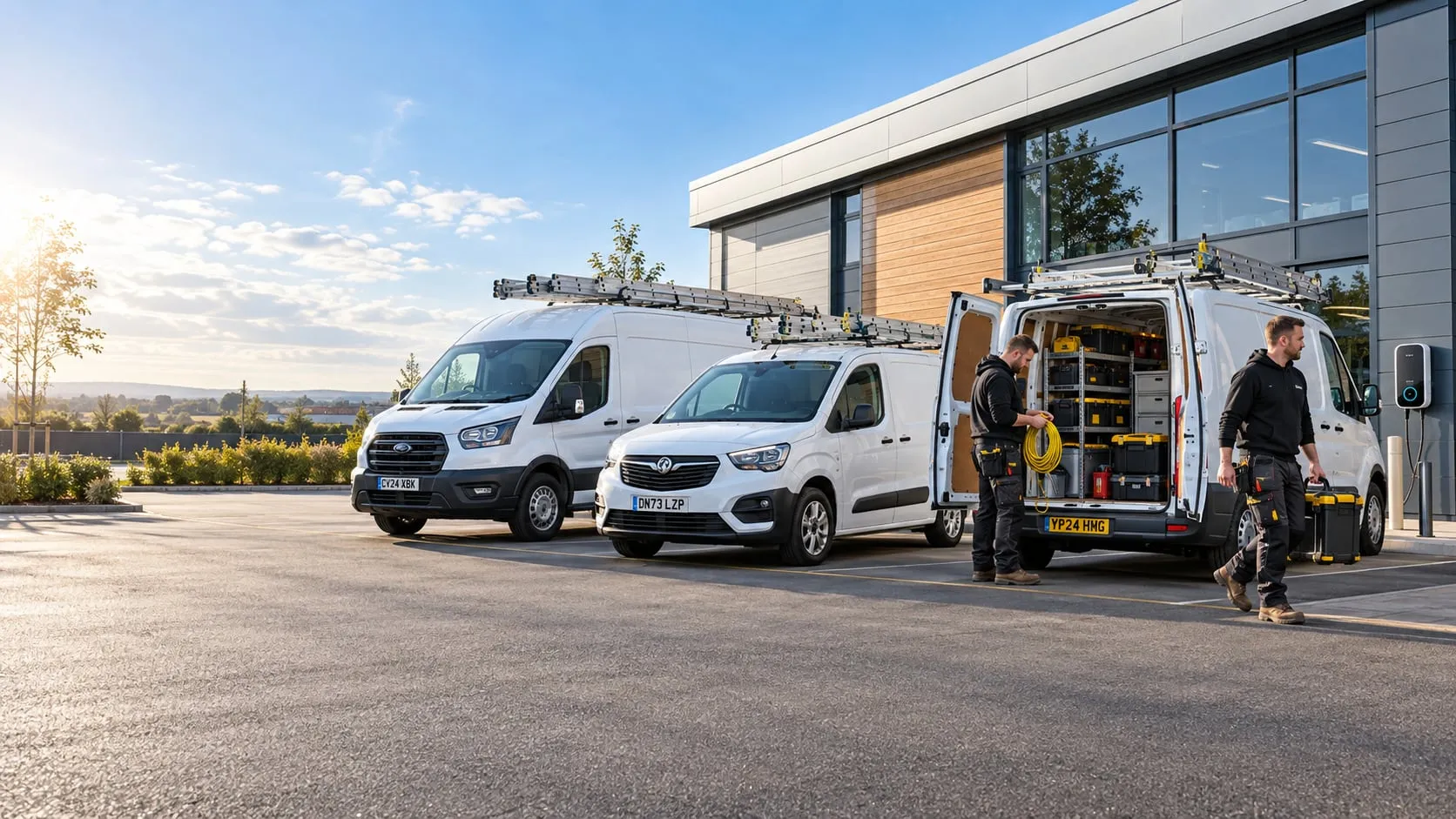
One policy for the vans your electrical business runs, from domestic rewires to commercial contracts and EV charger installs. One enquiry reaches brokers who quote on fleets.
- Vans carrying cable, tools and test equipment
- Call-out, on-call and apprentice drivers
- EV charger and solar installer fleets
Partnered with Quotezone
What being partnered with Quotezone means FleetQuote is a trading name of Simply Quote Comparison Ltd. Enquiries are passed to Quotezone, a trading style of Seopa Ltd (FCA FRN: 313860), which operates the quote panel. Simply Quote Comparison Ltd is an Introducer Appointed Representative of Seopa Ltd (FCA reference: 1011184), so we may be paid a commission if your enquiry leads to a policy. We do not give advice or make recommendations. Your choice of provider is entirely your own.FleetQuote is a quotation service, not an insurer or broker.
Last reviewed 17 September 2026
Fleet insurance quotes from the providers on our partner panel, including
















What insurers look at for electrical contractors
Underwriters want to know what is in the van, where it sleeps and when it is on the road.
-
Type of electrical work
Domestic, commercial, industrial, maintenance or renewables. Each has a different mileage pattern and a different value of kit on board.
-
Overnight parking
Whether vans go home with electricians or return to a locked unit, and what security the unit has.
-
Tools, cable and test kit
The typical and highest value of contents in any one van, and whether anything is left in vans overnight.
-
Apprentices and improvers
Whether apprentices drive, their ages and licence history, and which vans they are allowed to use.
-
Call-out work
Out-of-hours and emergency driving, on-call rotas and whether engineers drive straight from home to jobs.
Overview
Fleet insurance for electricians
Fleet insurance for electricians covers the vans, and often the cars, that an electrical business runs under one motor policy. Instead of a separate renewal for each van, the whole fleet sits on one schedule, and vans are added or removed as the team grows, contracts change or vehicles are replaced.
Electrical contractors carry a particular set of risks. Vans hold drums of copper cable that thieves target, test instruments worth more than many power tools, and customer equipment waiting to be installed.
Engineers often drive out of hours, and apprentices spend years on the tools before they qualify. For a broader introduction to the product itself, see van fleet insurance.
In short
Fleet insurance for electricians puts the business's vans, and any cars, on one motor policy with a single renewal date. Insurers focus on what the vans carry, such as cable and test equipment, where they are parked overnight, who drives, including apprentices, and out-of-hours call-out use. Tools and materials usually need separate or add-on cover.
At a glance
- Typical vehicles
- Panel vans up to 3.5 tonnes, crew vans, pool cars
- Usual class of use
- Business use and carriage of own goods
- Contents cover
- Tools and materials are not normally part of motor cover
- Electric vans on a car licence
- Up to 4,250kg for zero-emission vans (category B, GB)
- MID self-updates
- On and off-cover dates can be backdated by up to 14 days
- Typical fleet sizes
- Insurer-dependent; many fleet policies start from 2 or 3 vehicles
01
Which Electrical Businesses Does Fleet Cover Suit?
Electrical firms running several vehicles across domestic, commercial, maintenance or renewables work, where more than one or two people drive. The type of contract matters more to an underwriter than the trade label.
The work this page covers
- domestic rewires, consumer unit upgrades and periodic inspections
- commercial fit-out and industrial installation on larger sites
- planned maintenance and reactive call-outs under facilities contracts
- EV charge point installation for homes, workplaces and car parks
- solar PV and battery storage installation
- fire alarm, emergency lighting, data cabling or security system installation
Fleet sizes in the market
Insurers draw the line in different places, so treat any number as a guide rather than a rule. It is common market practice for fleet products to start at 2 or 3 vehicles, and mini-fleet products tend to cover up to somewhere around 12 to 20.
With two or three vans, compare the fleet route against multi-van insurance before committing to either.
02
How Does The Type Of Electrical Work Change The Risk?
Two electrical firms with the same number of vans can look very different to an underwriter. The type of work decides the mileage, the hours on the road and the value of what is in the back.
Four working patterns
| Type of work | Driving pattern | What the insurer will want to know |
|---|---|---|
| Domestic and small commercial | Several short trips a day, residential parking | Van values, overnight postcodes, tools left in vans |
| Commercial and industrial contracts | Daily trips to one site, sometimes long distances | Site parking security, crew vans, materials stored on board |
| Maintenance and call-outs | Unplanned journeys, evenings and weekends | On-call rota, vans kept at home, private use |
| EV charger and solar installs | Regional travel, heavier loads, roof work | Value and ownership of units carried, roof racks and ladders |
Firms that span more than one pattern
If your business mixes these, say so. A firm doing domestic rewires in the week and emergency call-outs at weekends needs the policy to reflect both.
03
Is Cable And Test Equipment Covered By The Motor Policy?
No. The motor policy insures the van and your liability to other road users, and cable, fittings and test instruments need their own cover through an add-on or a standalone policy.
Cable and materials
Copper cable has a scrap value, which makes vans carrying drums of it a target. Insurers that offer goods in transit or materials cover often set a limit per vehicle and may exclude theft from an unattended van overnight unless it is in a locked building or compound.
If your vans routinely carry large cable orders between the wholesaler and site, give the broker the typical and the highest value on board.
Test instruments and specialist tools
Multifunction installation testers, insulation resistance testers, thermal imaging cameras and cable locators can carry a high replacement value. Many tools policies have a single-item limit, so one instrument can exceed it on its own.
Keeping calibration records helps establish that an item existed and what it was worth. Ask whether cover applies in the van, on site and at an employee’s home.
Customer equipment on board
EV chargers, inverters, batteries and consumer units bought for a specific job may belong to your customer or be held on account from a distributor. Ask the broker whether your cover includes goods belonging to others while they are in your vans.
Contents checklist for the broker
- Typical and highest value of cable and materials in any one van
- A list of test instruments and tools worth more than a few hundred pounds each
- Whether contents stay in vans overnight, and where
- Whether vans have tool vaults, deadlocks or slam locks fitted
- Whether you carry equipment owned by customers or suppliers
04
What Does An Electrician’s Fleet Policy Actually Cover?
The vans themselves, at a cover level you choose, plus your liability to other road users. Class of use is normally business use plus carriage of own goods, because you carry your own tools and materials for your trade.
Cover levels
You pick a level for the vehicles: third party only, third party fire and theft, or comprehensive cover. Most working vans on a fleet are insured comprehensively, although that remains a decision for the business.
See tools in vehicle cover in our glossary for how contents cover usually works.
Add-ons electrical firms discuss
- tools in vehicle cover and goods in transit, as above
- a replacement or courtesy van, because a van off the road means cancelled jobs
- breakdown and recovery, which is usually bought separately or as an add-on
- legal expenses, to help recover uninsured losses after a non-fault accident
- windscreen cover
- personal use for engineers who keep vans at home
What sits outside the motor policy
Public liability and employers’ liability are separate business insurances. Neither forms part of a motor fleet policy, however many vans sit on it.
05
What Do Insurers Ask About Call-Outs And Vans Kept At Home?
How the on-call rota works, which engineers keep vans at their own address, and what those vans are allowed to be used for outside work. Each van’s overnight postcode becomes part of the theft rating.
Out-of-hours driving
Reactive maintenance and emergency call-outs put electricians on the road at night, at weekends and in poor weather, sometimes after a full day’s work. Insurers usually ask how on-call work is organised and whether engineers drive directly from home.
Tip: A simple on-call rule on maximum hours before driving, and a way for engineers to decline a late call-out if they are too tired, fits the HSE approach to driving for work and gives the broker something concrete to present.
Vans parked at engineers’ homes
Vans kept at engineers’ homes change the picture in three ways. The overnight postcode for each van becomes the theft rating address, and the trip from home to the first job may count as commuting.
The third is private use. If engineers can use the van for anything personal, social, domestic and pleasure use needs to be on the policy.
06
Can Apprentice Electricians Drive Company Vans?
Often yes, if the policy’s age and licence conditions allow it. Electrical apprenticeships run for several years, so this needs setting up at the start rather than assumed.
Age bands and named exceptions
Any-driver clauses usually carry a minimum age. If an apprentice is below it, the options are normally to name them individually, limit them to particular vans or choose a lower age band for the fleet.
Our page on any driver fleet insurance explains how these clauses and age bands work. An additional excess may apply when a young driver is involved in a claim.
Making an apprentice easier to insure
Keeping apprentices off the vans carrying the most valuable cable and instruments helps. So does pairing them with an experienced electrician for the first stretch of their driving.
07
Does Installing EV Chargers And Solar Change The Cover?
It can. Installers carry high-value units that often belong to the customer or a distributor, work at roof level, and travel further between jobs than a domestic electrician.
Electric vans above 3.5 tonnes
In Great Britain, a category B licence covers vans up to 3,500kg, or up to 4,250kg if the van is electric or hydrogen. Government guidance says drivers should practise before taking the heavier vehicles onto public roads.
If your installers drive zero-emission vans over 3,500kg, say so when you enquire. Our electric vehicle fleet insurance guide covers charging cables, repairs and home charging.
Roof equipment and loads
Ladder racks, roof bars and panel carriers are modifications, so declare them. Panels, batteries and inverters are heavy, and a van loaded with them can end up close to its plated weight.
Travel and overnight stays
Regional installation work adds mileage and sometimes overnight stays away from base. Insurers rate that differently from local domestic work, so describe the real travel pattern rather than the home postcode alone.
08
What Do Underwriters Ask Electrical Contractors?
For the vehicle schedule, the driver list and the split of work, then the contents values and claims record. The questions are the same whether you run three vans or thirty.
The question list
- the split between domestic, commercial, industrial and renewables work
- driver ages, licence history, convictions and claims, including apprentices
- annual mileage per van and the areas you cover
- overnight parking for each van, and security at any unit or yard
- contents values, as in the checklist above
- claims experience for the fleet over recent years
- whether subcontract electricians ever drive your vans
- telematics, trackers or dashcams fitted
Why the answers matter
Each answer narrows the rating. A fleet with vans emptied into a locked unit every night sits differently from one where loaded vans stand on residential streets.
09
How Do You Keep The MID And Licence Records Right?
Every van on the policy must appear on the Motor Insurance Database, and every driver’s licence needs checking. Both are routine jobs that cause real trouble when they slip.
The Motor Insurance Database
Every van on the policy must appear on the Motor Insurance Database, which police check at the roadside. Add replacement vans as soon as they arrive and remove sold ones when they leave.
Where you update records yourself through MIB’s Navigate portal, on-cover and off-cover dates can only be backdated by up to 14 days, and your policy may set a shorter deadline. Anyone can check whether a vehicle shows as insured at askMID.
Licence checks
The HSE expects employers to manage work-related road risk, including checking that drivers’ licences are valid. A driver can share their licence record with you using a check code from GOV.UK, which lasts 21 days and works once.
Add licence checks to the same annual cycle as other competence checks, and our guide to driving licence checks sets out the detail.
10
When Is Fleet Cover The Wrong Fit For An Electrical Firm?
When there is really only one van, when the contents are worth more than the vehicles, or when the vehicles belong to the people driving them rather than the business.
Four situations where something else fits better
- A sole trader with one van, or one van plus an apprentice’s car, is usually insured on an individual commercial van policy.
- Self-employed electricians using their own vans need their own insurance, because a fleet policy does not cover vehicles you do not own or lease.
- If tools and stock are worth more than the vans, a standalone tools or contents policy may be the more important purchase.
- Staff using their own cars for estimating visits need business use on their own policies, which is grey fleet rather than fleet cover.
11
What Keeps An Electrical Fleet’s Costs Under Control?
Taking the valuable contents out of the picture overnight, keeping the least experienced drivers off the best-stocked vans, and running an accurate schedule. Nothing here promises a price.
Practical levers
- empty high-value cable and instruments from vans overnight where you can
- fit tool vaults, deadlocks and trackers, and say so when you enquire
- keep apprentices on lower-value vans until they have more experience
- limit personal use to engineers who need it
- keep a clean, current schedule and update it promptly
- review every incident with the driver, however minor
Renewal and related trades
Work through the fleet insurance renewal checklist a few weeks before the date rather than the week of it. Plumbing and heating firms share many of these risks, so if your business covers both trades see fleet insurance for plumbers.
Before you enquire
What to have to hand
What you’ll need for a quote
You can start an enquiry without all of this. The broker will ask for anything missing.
- Number and types of vehicles (rough is fine to start)
- Renewal date and current policy schedule
- Claims experience letter from your current insurer
- Driver ages and any penalty points
- Where vehicles are kept overnight
Sources
Updates
- : last reviewed
General information about UK fleet insurance, not advice. How we write and check our content

Ready to get started?
Fleet insurance enquiries for electrical contractors businesses
One enquiry covering the vehicles, drivers and work involved. A specialist broker uses that detail to discuss cover that fits how your business actually runs.
FleetQuote is an introduction service, not an insurer or broker. We pass your enquiry to Quotezone, which operates a panel of brokers and insurers. How our service works
Questions
Fleet insurance for electricians: common questions
Is cable carried in an electrician's van covered by fleet insurance?
Not by the motor cover itself. A fleet policy protects the vans and your liability to other road users. Cable, fittings and other materials are usually covered by a goods in transit extension or a separate policy, often with a limit per vehicle. Because copper cable is a common theft target, some insurers set conditions on leaving it in vans overnight, so check the wording.
Are multifunction testers and other test equipment covered as tools?
Test instruments are often treated as tools, but some tools policies set a single-item limit that expensive testers or thermal cameras can exceed. List high-value items separately when you talk to the broker, with rough replacement values. Also ask whether cover applies while equipment is in the van, on site and at an employee's home.
Can apprentice electricians drive company vans?
Often, yes, if the policy's age and licence conditions allow it. Some fleet policies set a minimum driver age that younger apprentices don't meet, in which case they may need to be named individually or restricted to certain vans. An additional excess may apply when a young driver is involved in a claim. Give the broker every likely driver's age and licence details.
Do electricians on call need a different class of use?
Call-out driving is still business use, but vans kept at home and used for the journey to the first job raise questions about commuting and personal use. If engineers can use vans privately, social, domestic and pleasure use needs adding. Explain your on-call arrangements to the broker so the class of use matches what really happens.
Can an electrician drive a heavier electric van on a car licence?
In Great Britain, a category B licence covers vans up to 3,500kg maximum authorised mass, or up to 4,250kg if the van is zero-emission, meaning electric or hydrogen. Government guidance says drivers should practise before driving the heavier vehicles on public roads. Tell the broker if any electric vans on your fleet are above 3,500kg.
We install EV chargers and solar panels. Does that change our fleet insurance?
It can. Installers often carry high-value units belonging to the customer or a distributor, plus ladders and roof equipment, and may travel further between jobs than a domestic electrician. Insurers will want to know what is carried, its value, who owns it and how far vans travel. Declare roof racks, ladder racks and any racking added for panels or chargers.
Related reading
- Cover Fleet insurance for plumbers Fleet insurance for plumbers and heating engineers. Boiler and copper stock in vans, gas bottles, on-call engineers, racking and apprentices explained.
- Cover Van fleet insurance Van fleet insurance explained for UK firms running two or more vans. Class of use, tools and goods cover, security, conversions and what insurers ask.
- Cover Any driver fleet insurance Any driver fleet insurance explained. How any-driver, named and open driving clauses differ, age bands, licence conditions, excesses and employer duties.
- Cover Multi-van insurance Multi-van insurance for UK businesses with two or more work vans and several drivers. Driver options, class of use, tools in vans and adding a van mid-term.
- Guide Electric vehicle fleet insurance What changes when you insure electric cars and vans on a fleet policy, from repairs and batteries to charging cables, heavier vans on a car licence and driving.
- Guide Driving licence checks for employers How UK employers check driving licences with DVLA check codes or bulk checking services, how often to check, getting consent, and what insurers may ask.
- Guide Fleet insurance renewal checklist A practical fleet insurance renewal checklist covering timing, vehicle schedules, driver licence checks, claims experience and avoiding a gap in cover.
What FleetQuote does, and doesn't do
FleetQuote is a trading name of Simply Quote Comparison Ltd (company number 15008284), registered office Sentinel House, Ancells Business Park, Harvest Crescent, Fleet, Hampshire, GU51 2UZ.
Simply Quote Comparison Ltd is an Introducer Appointed Representative of Seopa Ltd (Financial Conduct Authority reference 1011184). We are not authorised in our own right: we act under Seopa Ltd, which is authorised and regulated by the Financial Conduct Authority under reference 313860.
That permission covers introducing your enquiry and nothing more. We do not provide insurance, arrange insurance, recommend a policy or give advice.
When you send an enquiry we introduce you to Quotezone, a trading style of Seopa Ltd (FCA FRN 313860), which operates a panel of brokers and insurers. Any quote, advice or policy comes from them, not from FleetQuote.
Simply Quote Comparison Ltd is paid a commission when an enquiry leads to a policy, at no cost to you. It is free to enquire and you are under no obligation to buy.