Fleet insurance by industry
Fleet Insurance for Plumbers
One motor policy for the vans your plumbing and heating business relies on, from boiler installs to emergency repairs. One enquiry reaches brokers who quote on fleets.
- Vans carrying boilers, cylinders and copper
- On-call engineers with vans at home
- Racking, pipe carriers and conversions declared
Partnered with Quotezone
What being partnered with Quotezone means FleetQuote is a trading name of Simply Quote Comparison Ltd. Enquiries are passed to Quotezone, a trading style of Seopa Ltd (FCA FRN: 313860), which operates the quote panel. Simply Quote Comparison Ltd is an Introducer Appointed Representative of Seopa Ltd (FCA reference: 1011184), so we may be paid a commission if your enquiry leads to a policy. We do not give advice or make recommendations. Your choice of provider is entirely your own.FleetQuote is a quotation service, not an insurer or broker.
Last reviewed 17 September 2026
Fleet insurance quotes from the providers on our partner panel, including
















What insurers look at for plumbing and heating fleets
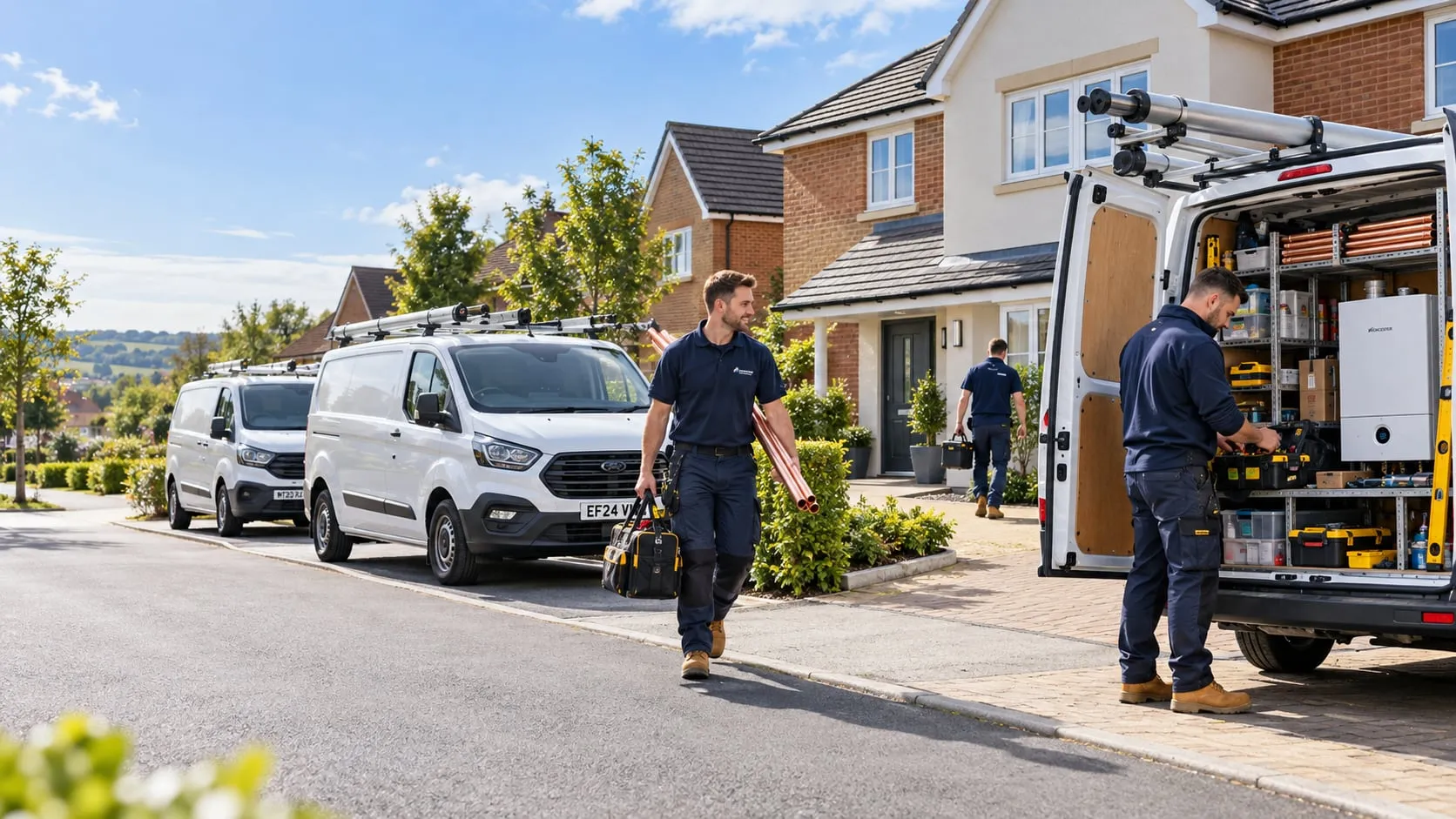
A plumbing van is part workshop and part stores, and the underwriter prices both.
-
Stock on board
Boilers, cylinders, radiators and copper waiting to be fitted, and how long they stay in the van before the job.
-
Vans kept at home
Home postcodes for engineers who take vans home, and whether they can use them outside work.
-
Gas and brazing equipment
LPG, oxy-acetylene or other cylinders carried, and how they are secured and ventilated.
-
Racking and roof carriers
Shelving, pipe tubes, ladder racks and ply lining, declared as modifications.
-
Job pattern
Many short residential trips, service contract rounds or longer drives to new-build and commercial sites.
-
Claims history
Recent claims across the fleet, including theft from vans and minor parking damage.
Overview
Fleet insurance for plumbers
Fleet insurance for plumbers brings a plumbing and heating firm’s vans under one motor policy, so there is one renewal, one schedule and one set of driving conditions to manage. It fits businesses whose engineers each run a van, from a small bathroom and heating firm to a contractor with service and breakdown contracts across a region.
A plumber’s van is not an ordinary van to an insurer. On a given day it can hold a new combination boiler, lengths of copper tube, a brazing kit and boxes of fittings, parked on a residential street while the engineer works inside.
Many heating engineers also take their vans home for on-call cover. This page works through those issues and what a broker will want to know.
In short
Fleet insurance for plumbers puts a plumbing and heating firm's vans on one motor policy. Underwriters look closely at stock carried between merchant and job, such as boilers and copper, at on-call engineers who keep vans at home, at gas cylinders and brazing kits, and at who drives. Stock and tools usually need cover beyond the motor policy itself.
At a glance
- Typical vehicles
- Small and medium panel vans, some Luton or crew vans
- Usual class of use
- Business use and carriage of own goods; personal use if vans go home
- Stock and tools
- Usually an add-on or separate policy, not part of motor cover
- Car licence limit
- Category B covers up to 3,500kg (4,250kg zero-emission) in GB
- Operator licence
- Not needed for vans up to 3,500kg used only in the UK
- Typical fleet sizes
- Varies by insurer; fleet products often start at 2 or 3 vehicles
01
Why Is A Plumbing Van Treated Like A Mobile Stores?
Because most plumbing and heating firms buy materials job by job from merchants, so a lot of stock spends time in vans. That creates a split between what the motor policy covers and what it does not.
What sits where
| What is in the van | How it is usually treated | Question for the broker |
|---|---|---|
| Boilers, cylinders, radiators and heat pump units | Stock or goods in transit | Is there a per-van limit, and does cover continue overnight? |
| Copper tube, fittings and valves | Stock or materials | Is theft of materials from a locked van covered? |
| Press tools, pipe freezers and flue gas analysers | Tools | Is there a single-item limit? |
| Gas and brazing cylinders | Declared as part of the risk | Are there conditions on how they are carried? |
The van itself, and your liability to other road users, sits under the fleet policy. Everything in the table normally needs an add-on or separate cover.
Copper and resale value
Copper has a resale value, so some insurers attach conditions to theft of materials from unattended vans.
Give the broker the value of the most expensive load a single van carries, not the average. The limit is what decides a stock claim.
02
Which Plumbing And Heating Businesses Does This Suit?
Firms where each engineer runs a van and the work is spread across installs, servicing or site contracts. Fleet size rules are set by insurers rather than by law.
The businesses this page is aimed at
- domestic plumbing and heating firms fitting boilers, bathrooms and central heating
- gas engineers running boiler service and breakdown contracts
- heat pump and renewable heating installers
- social housing and letting agency maintenance contractors
- commercial mechanical and plumbing contractors working on new-build sites
Where the fleet threshold sits
It is common market practice for fleet products to begin at 2 or 3 vehicles, while mini-fleet products generally stop somewhere between about 12 and 20.
With only two or three vans, look at multi-van insurance alongside the fleet route. A one-van business will normally be better served by an individual commercial van policy.
03
What Does The Fleet Policy Cover And What Needs Adding?
The vans are insured at a level you choose, with carriage of own goods as the usual class of use because the stock and tools belong to the business. Stock, tools and recovery are the add-ons that come up most.
Cover level and class of use
The vans themselves are insured comprehensively, on third party fire and theft, or on third party only. Carriage of own goods is the usual class of use, and our guide to vehicle class of use explains the differences.
If any van ever carries materials for another company for a fee, raise it, because that may count as hire and reward.
The add-ons that matter to a plumbing firm
- Stock or goods in transit cover for boilers, cylinders and materials between merchant and job
- Tools cover for press tools, analysers, drain cameras and power tools
- Breakdown and recovery, often arranged separately, because a van stuck on the roadside means missed appointments
- Courtesy or replacement van provision, and whether it can carry your racking and stock
- Legal expenses to pursue uninsured losses after an accident that was not your driver’s fault
- Windscreen cover
Vans used outside the UK
Carrying goods for payment abroad is a different question from carrying your own materials. GOV.UK sets out the position for transporting goods out of the UK using vans, and it is worth checking before a van leaves the country.
04
How Does A Gas Safe Engineer’s Working Pattern Affect The Risk?
It sets the mileage, the number of stops and the type of claim. A service engineer on a contract round may visit several homes a day, parking on residential streets and leaving the van while they work.
Registration and the pattern it creates
In Great Britain, a business or self-employed engineer doing gas work within the scope of the Gas Safety (Installation and Use) Regulations 1998 must be on the Gas Safe Register. For insurance, the registration itself matters less than the working pattern it creates.
Insurers usually want the typical number of visits, annual mileage per van and the area covered.
Short town trips against long site runs
Short, frequent trips in towns bring a different kind of claim, such as low-speed manoeuvring and parking damage. Long motorway journeys to commercial sites bring another, so explain which pattern fits each van.
Tip: Remind engineers to lock the van every time they go into a property, even for a quick check. Many theft-from-vehicle conditions depend on the van being locked, and a claim for tools taken from an unlocked van may not be paid.
05
What Changes When Engineers Take Vans Home For On-Call?
Each van’s rating address becomes the engineer’s home postcode, and the policy has to allow for the journey to the first job and any private use. Boiler breakdowns do not keep office hours.
Four things that shift on the policy
- each van’s rating address becomes the engineer’s home postcode
- the home-to-first-job journey may need commuting cover
- personal use at evenings and weekends needs social, domestic and pleasure cover
- stock left in vans at home overnight may be subject to extra conditions
Changing the rota mid-term
Give the broker an accurate list of which vans go home and with whom. If you change the on-call arrangement mid-term, for example adding a winter rota, raise it at the time, because a business must make a fair presentation of the risk when a policy is varied as well as at the start under section 3 of the Insurance Act 2015.
06
Do You Have To Declare Gas Bottles And Brazing Kits?
Yes. LPG, oxy-acetylene, MAPP and similar cylinders add a fire risk, and how they are carried is part of the risk an insurer is pricing.
What HSE guidance says about carrying cylinders
HSE guidance says acetylene cylinders should be carried in open vehicles where reasonably practicable, and a closed van carrying them must have ventilation fitted to the load space. That position comes from HSE’s acetylene research.
Industry guidance also generally recommends keeping cylinders upright and secured, and not leaving them in vans longer than needed.
What to declare
Declare what you carry, typical quantities and whether cylinders stay in vans overnight. Vented cylinder lockers are worth mentioning if you have them fitted, along with blowtorches and solvents carried alongside.
07
Does Racking And Pipe Carriers Need Declaring?
Yes. A plumbing van is usually fitted out to carry long lengths of pipe and hundreds of fittings, and every one of those fit-outs is a modification.
The modifications to list
- shelving and drawer units for fittings
- roof-mounted pipe tubes and ladder racks
- ply lining and non-slip floors
- cylinder lockers and secure tool vaults
- tow bars for trailers carrying heavier units
Why invoices matter
Fit-outs add value, affect repair costs and are easy to forget. Our fleet schedule template has space to record modifications against each van, and keeping the invoices helps show what a van was worth after a write-off.
08
What Happens When A Plumbing Van Nears 3.5 Tonnes?
Above 3,500kg the driver needs C1 entitlement, and a goods vehicle operator’s licence generally comes into play for business use. Heating installers often move up a size to carry cylinders and heat pump units.
Licence entitlement
In Great Britain, a category B licence covers vehicles up to 3,500kg maximum authorised mass, or up to 4,250kg for zero-emission vans, under the GOV.UK driving licence categories. Above that a driver needs C1 entitlement.
Many drivers who passed their car test before 1 January 1997 already hold C1, although the DVLA record is what counts.
Operator licensing
An operator’s licence is not needed for vans up to 3,500kg used only within the UK. It generally is needed for goods vehicles over 3,500kg gross plated weight used for business, including carrying your own goods.
If a van is plated close to the limit, check the plate before loading it heavily and give the broker its gross vehicle weight.
09
Can A Plumbing Apprentice Drive A Company Van?
Often yes, once their age and licence meet the policy conditions. Apprentices usually start as passengers travelling with a qualified engineer, and the insurance question arrives the day they first drive.
Checking before they drive
Check age and licence against the policy conditions before an apprentice takes a van to the merchant or between jobs. If the fleet’s age band does not include them, they can often be named individually or restricted to one van.
Our page on any driver fleet insurance explains age bands and named exceptions, and the young drivers guide covers the extra excess that can apply.
10
What Do Underwriters Ask Plumbing And Heating Businesses?
For the work mix, the driver list, which vans go home, the stock and tools values, and anything hazardous on board. The claims record sits behind all of it.
The question list
- the mix of domestic installs, service contracts, commercial and new-build work
- driver details, including ages, licence history and any claims or convictions
- which vans go home, and the home postcodes
- the most valuable stock load and the tools value per van
- gas cylinders and other hazardous items carried
- modifications and security fitted to each van
- claims experience for the fleet over recent years
Licence checks as evidence
HSE guidance on making sure drivers are safe expects employers to confirm that drivers are licensed and competent for the vehicle. Checking at recruitment and at regular intervals gives the broker something concrete to present.
11
When Is Fleet Cover The Wrong Fit For A Plumbing Firm?
When there is one van, when the engineers bring their own, when the vehicles are specialist drainage units, or when the stock lives in a unit rather than in vans.
Four situations where something else fits better
- A one-van sole trader will normally use an individual commercial van policy rather than a fleet schedule.
- Self-employed engineers who bring their own vans need their own insurance, because a fleet policy covers vehicles the business owns or leases.
- Drainage firms running jetting units or tankers may need a specialist commercial vehicle policy.
- Stock held in a unit rather than vans makes business contents or stock cover matter more than the motor policy.
12
How Can A Plumbing Fleet Keep Costs Under Control?
By taking the valuable stock out of vans overnight, keeping on-call vans with the steadiest drivers, and running an accurate schedule. None of it promises a price.
Practical levers
- Unload boilers and high-value stock when the working day finishes, where possible
- Fit vaults, deadlocks and cylinder lockers, and say so when you enquire
- Keep on-call vans to engineers with good driving records
- Restrict personal use to the people who need it
- Keep every van on the Motor Insurance Database from the day it arrives
- Check licences at recruitment and at regular intervals
Keeping the database straight
A van missing from the Motor Insurance Database can be stopped by police even when it is covered, and anyone can check a registration through MIB’s vehicle check. Our guide on the Motor Insurance Database for fleets explains who updates the record.
Related trades
Electrical contractors face similar questions about tools and apprentices. If your business also employs electricians, see fleet insurance for electricians.
Before you enquire
What to have to hand
What you’ll need for a quote
You can start an enquiry without all of this. The broker will ask for anything missing.
- Number and types of vehicles (rough is fine to start)
- Renewal date and current policy schedule
- Claims experience letter from your current insurer
- Driver ages and any penalty points
- Where vehicles are kept overnight
Sources
- GOV.UK: Driving licence categories
- GOV.UK: Being a goods vehicle operator
- GOV.UK: Transport goods using vans or car and trailers
- MIB: Check your vehicle
- HSE: Make sure drivers and riders are safe
- Insurance Act 2015, section 3
- Gas Safety (Installation and Use) Regulations 1998, regulation 3
- HSE: Gas Safe Register
- HSE: Acetylene research (transporting cylinders)
Updates
- : last reviewed
- : Legal and regulatory points checked against official sources
General information about UK fleet insurance, not advice. How we write and check our content
Ready to get started?
Fleet insurance enquiries for plumbing and heating businesses
One enquiry covering the vehicles, drivers and work involved. A specialist broker uses that detail to discuss cover that fits how your business actually runs.
FleetQuote is an introduction service, not an insurer or broker. We pass your enquiry to Quotezone, which operates a panel of brokers and insurers. How our service works
Questions
Fleet insurance for plumbers: common questions
Is a boiler waiting to be fitted covered while it is in the van?
Usually not under the motor policy. A new boiler, cylinder or radiator in the back of a van is stock or goods in transit, and needs cover through an add-on or a separate policy. Check the limit per vehicle against the most expensive load you carry, and ask whether cover continues if the van is left overnight with stock inside.
Do I need to tell the insurer we carry gas bottles in our vans?
Yes. Declare any LPG, oxy-acetylene, MAPP or similar cylinders carried for brazing, soldering or testing. Insurers may ask how cylinders are secured, whether the van is ventilated and whether they are removed overnight. Leaving out something that affects the fire risk could cause problems with a claim, so mention it even if the cylinders are small.
Our heating engineers take vans home for on-call work. What do we need to tell the broker?
Give the home postcode for every van that is kept at an engineer's address, since that is where the theft risk sits overnight. Explain whether vans are used for the journey to the first job and whether personal use is allowed. If engineers can use vans for anything personal, social, domestic and pleasure use needs to be added to the policy.
Can a plumbing apprentice drive a company van?
It depends on the policy's driving conditions. Many fleet policies set a minimum driver age, and a younger apprentice may need to be named individually or limited to particular vans. Some insurers apply an extra excess when a young driver is at the wheel. Share each apprentice's age and licence details with the broker before they start driving.
Does van racking need to be declared on a plumbing fleet policy?
Yes. Racking, drawer units, pipe carriers, roof racks, ladder racks and ply lining are modifications. They add value and can affect repair costs. Declare them when you enquire and keep invoices, which help show what the van was worth after a theft or write-off.
Is fleet insurance suitable for a two-van plumbing business?
It can be. Fleet thresholds depend on the insurer, and some products start at two or three vehicles. With only two vans, individual van policies or a multi-van arrangement may be simpler, so ask the broker to explain the options for your business before choosing.
Related reading
- Cover Fleet insurance for electricians Fleet insurance for electricians and electrical contractors. Cable and test kit in vans, call-outs, apprentices, EV charger and solar installer fleets.
- Cover Multi-van insurance Multi-van insurance for UK businesses with two or more work vans and several drivers. Driver options, class of use, tools in vans and adding a van mid-term.
- Cover Van fleet insurance Van fleet insurance explained for UK firms running two or more vans. Class of use, tools and goods cover, security, conversions and what insurers ask.
- Cover Any driver fleet insurance Any driver fleet insurance explained. How any-driver, named and open driving clauses differ, age bands, licence conditions, excesses and employer duties.
- Guide The Motor Insurance Database and your fleet How the Motor Insurance Database works for fleet policies, who updates vehicle records, what the 14-day backdating limit means and how to check askMID.
- Guide Young drivers and fleet insurance How fleet insurers treat young and newly qualified drivers, covering age restrictions, young driver excesses, apprentices, training and graduated vehicle access.
- Guide Fleet insurance renewal checklist A practical fleet insurance renewal checklist covering timing, vehicle schedules, driver licence checks, claims experience and avoiding a gap in cover.
What FleetQuote does, and doesn't do
FleetQuote is a trading name of Simply Quote Comparison Ltd (company number 15008284), registered office Sentinel House, Ancells Business Park, Harvest Crescent, Fleet, Hampshire, GU51 2UZ.
Simply Quote Comparison Ltd is an Introducer Appointed Representative of Seopa Ltd (Financial Conduct Authority reference 1011184). We are not authorised in our own right: we act under Seopa Ltd, which is authorised and regulated by the Financial Conduct Authority under reference 313860.
That permission covers introducing your enquiry and nothing more. We do not provide insurance, arrange insurance, recommend a policy or give advice.
When you send an enquiry we introduce you to Quotezone, a trading style of Seopa Ltd (FCA FRN 313860), which operates a panel of brokers and insurers. Any quote, advice or policy comes from them, not from FleetQuote.
Simply Quote Comparison Ltd is paid a commission when an enquiry leads to a policy, at no cost to you. It is free to enquire and you are under no obligation to buy.