Fleet insurance
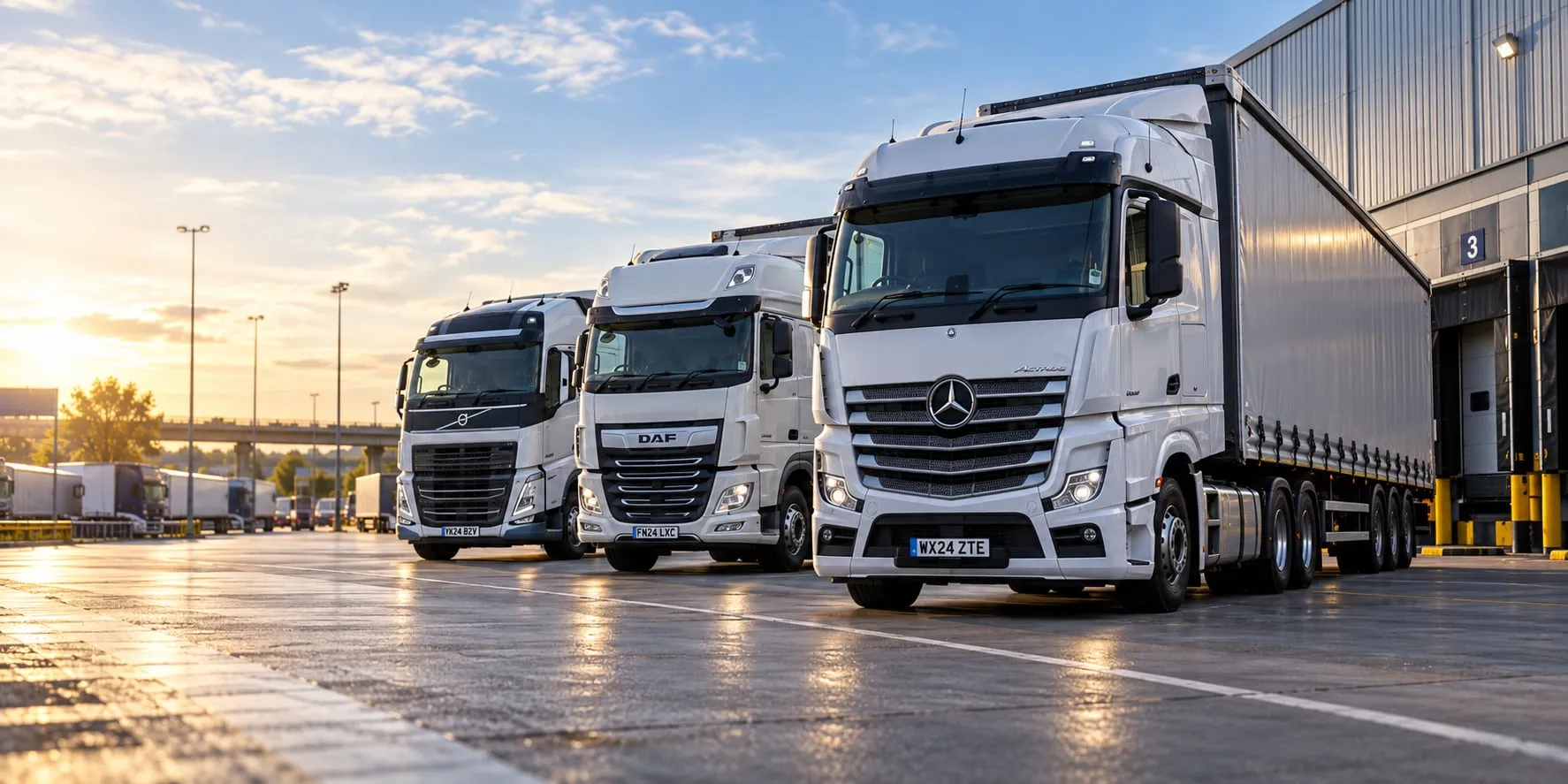
HGV Fleet Insurance
Cover for two or more goods vehicles over 3.5 tonnes, from 7.5 tonne rigids to artics and trailers. One enquiry covers the lorries and their trailers, and brokers quote from there.
- Rigids, tractor units, tippers and trailers
- Haulage and own-account operators
- Goods in transit and European use options
Partnered with Quotezone
What being partnered with Quotezone means FleetQuote is a trading name of Simply Quote Comparison Ltd. Enquiries are passed to Quotezone, a trading style of Seopa Ltd (FCA FRN: 313860), which operates the quote panel. Simply Quote Comparison Ltd is an Introducer Appointed Representative of Seopa Ltd (FCA reference: 1011184), so we may be paid a commission if your enquiry leads to a policy. We do not give advice or make recommendations. Your choice of provider is entirely your own.FleetQuote is a quotation service, not an insurer or broker.
Last reviewed 17 September 2026
Fleet insurance quotes from the providers on our partner panel, including
















What insurers look at for HGV fleets
-
Your O-licence
The licence type, how many vehicles it authorises and whether your use of the fleet sits inside it.
-
Whose goods you carry
Own-account operators and hauliers carrying for payment are rated as different risks, and the class of use must match.
-
Driver entitlement
C1 or C categories on the DVLA record, experience on heavy vehicles and any points or claims.
-
Operating radius
Local distribution, national trunking and international work each change the exposure.
-
Cameras and telematics
Forward and side cameras help with disputed claims involving cyclists, pedestrians and lane changes.
-
Maintenance records
Inspection sheets, defect reports and walkaround checks show the fleet is looked after.
Overview
HGV fleet insurance
HGV fleet insurance covers two or more goods vehicles over 3.5 tonnes on one policy: rigid lorries, tractor units, tippers, box and curtainside bodies, and usually the trailers that go with them. It is used by hauliers moving other people’s goods for payment, and by own-account operators such as builders’ merchants, wholesalers and manufacturers who run lorries to deliver their own stock.
Heavy goods vehicles raise questions that vans and cars never do. Insurers want to know about your operator’s licence, your drivers’ licence categories, what is on the back of the vehicle and how far it travels.
This page works through those questions for HGV operators specifically. For how fleet policies work in general, see our fleet insurance overview.
In short
HGV fleet insurance puts two or more goods vehicles over 3.5 tonnes, and usually their trailers, on one policy. Insurers look closely at whether you carry your own goods or other people's for payment, your operator's licence, your drivers' licence categories and experience, what you carry and where. Goods in transit and liability for lifting equipment often need separate cover.
At a glance
- Vehicles
- Goods vehicles over 3,500kg gross plated weight, plus trailers
- Operator licence (GB)
- Generally needed to use goods vehicles over 3,500kg for business, including carrying your own goods
- O-licence types
- Restricted (own goods only), standard national, standard international
- Driving licence categories
- C1 for 3,500kg to 7,500kg; C for over 3,500kg
- Legal minimum cover
- Third party, under Road Traffic Act 1988 section 143
- Insurance Premium Tax
- 12% standard rate on most motor insurance
- Fleet sizes
- Insurer-dependent; many fleet products start from 2 or 3 vehicles
01
Which Operators Need HGV Fleet Insurance?
Businesses running two or more goods vehicles over 3.5 tonnes as part of daily operations, whether they carry other people’s goods for payment or move their own stock. A single lorry is normally insured on an individual commercial vehicle policy instead.
Typical operators
- General hauliers running rigids and artics on contract or spot work
- Pallet network members and regional distribution firms doing trunking and local delivery
- Own-account operators delivering their own products, such as timber merchants, food producers and drinks distributors
- Construction and aggregates firms with tippers, grab lorries, mixers and low loaders
- Specialist operators such as skip loaders, recovery trucks and crane lorries
- Temperature-controlled carriers with refrigerated bodies and trailers
Fleet sizes
Insurer thresholds vary. As general market practice, many fleet products start from 2 or 3 vehicles, and mini-fleet products often run up to roughly 12 to 20 vehicles.
Some insurers only write HGVs above a certain fleet size, or only with a minimum amount of operating history. If most of your vehicles are vans and you run one or two lorries alongside them, a mixed fleet insurance policy may suit the shape of your business better than an HGV-specific scheme.
02
Why Does Haulage Or Own Account Make Such A Difference?
Whose goods your lorries carry decides your class of use, your operator’s licence type and much of the underwriting. Carrying other people’s goods for payment is rated differently from moving your own stock.
The four operating positions
| How you operate | What you carry | Class of use to declare | O-licence type (GB) |
|---|---|---|---|
| Own account | Your own goods only | Carriage of own goods | Restricted is enough |
| UK haulier | Other people’s goods for payment, in the UK | Hire and reward (haulage) | Standard national |
| International haulier | Other people’s goods, in the UK and abroad | Hire and reward, with European use | Standard international |
| Mixed | Both, on different vehicles or days | Both, declared per vehicle | Standard national or international |
What each licence type allows
A restricted licence lets you carry your own goods in the UK or abroad, but not other people’s. A standard national licence adds other people’s goods within the UK, and a standard international licence covers your own and other people’s goods on international journeys too.
GOV.UK sets each option out on its page about types of goods vehicle operator licence. For more on the classes themselves, read our guide to vehicle class of use.
Why hire and reward is rated higher
Insurers rate hire and reward work differently from own-account work because of the mileage, the time pressure of delivery slots and the liability to customers for their goods. Hauliers usually trade on written conditions of carriage, and those conditions affect what your goods in transit cover needs to do.
Watch out: An own-account operator that takes a paid load for another company, even once as a favour, may be working outside both a restricted O-licence and a carriage of own goods policy. Talk to the broker before the first job, not after an incident.
03
What Does An HGV Fleet Policy Cover, And What Needs Adding?
The motor policy covers the lorries and your liability to other road users, at third party only, third party fire and theft or comprehensive cover. The load, the trailers and the lifting equipment usually need cover arranged on top of it.
Cover levels
Third-party cover is the legal minimum under section 143 of the Road Traffic Act 1988, and it covers your liability for injury to other people and damage to their property. Comprehensive cover adds damage to your own vehicles.
Given what a tractor unit or a specialist body costs to repair or replace, most operators look at comprehensive cover for at least their newer vehicles.
Goods in transit
The motor policy insures the lorry, not the load. Goods in transit cover protects goods while they are carried, loaded and unloaded, and it is often arranged as an extension or a separate policy.
When discussing it with the broker, have ready:
- the type of goods, including anything high value, hazardous or temperature sensitive
- the typical and maximum value on any one vehicle
- the conditions of carriage you trade under, if you are a haulier
- where loaded trailers are parked overnight
Refrigerated loads raise a further question: whether spoilage caused by a fridge unit breaking down is covered. Some goods in transit policies treat that as a separate extension.
Trailers
List every trailer with its type and value. Say whether you pull customers’ trailers or swap trailers with other operators, because damage to a trailer you do not own may need specific cover.
Ask how liability works when a trailer is detached and parked, as well as when it is coupled to a unit.
Lifting and working equipment
Lorry-loader cranes, tail lifts, tipper bodies, bulk blowers and concrete pumps create risks that arise while the vehicle is parked and working. A motor policy may not respond in full to injury or damage caused while that equipment is being operated, and depending on the policy the gap may be filled by a working-risks extension or by public liability cover.
Lifting equipment also carries its own legal inspection duties. Under the Lifting Operations and Lifting Equipment Regulations 1998 (LOLER), it needs thorough examination by a competent person, usually every 6 or 12 months, and an insurer may ask to see the reports.
Breakdown and time off the road
Recovering a loaded artic is a specialist job and is priced accordingly. Breakdown cover for heavy vehicles is usually bought separately or added as an extension, and our guide to fleet breakdown cover explains the options.
Also ask whether the policy offers anything towards the cost of a replacement vehicle while one is repaired, because this is not standard on every HGV policy.
04
What Do Insurers Ask About An HGV Fleet?
Vehicles, use, operating radius, parking, drivers, claims history and the controls you have in place. Underwriters build their view from those seven areas, and the answers on parking and driver experience carry a lot of the weight.
The areas underwriters cover
| Area | What you’ll be asked | Why it matters |
|---|---|---|
| Vehicles | Gross plated weight, body type, age, value | Repair cost and severity of any collision |
| Use | Own goods or hire and reward, typical goods | Liability to customers and theft appeal of loads |
| Radius | Local, regional, national or international | Mileage, unfamiliar roads, time away from base |
| Parking | Operating centre security, nights out, truck stops | Theft of vehicles, trailers and loads |
| Drivers | Ages, categories held, years on HGVs, convictions | Driver experience is closely tied to claims |
| History | Several years of claims experience | Shows how the fleet has performed in practice |
| Controls | Cameras, telematics, maintenance, driver training | Evidence that risk is actively managed |
Nights out
Nights out matter more than many operators expect. A loaded curtainsider in an unsecured layby is a very different theft risk from one parked in a lit, fenced yard.
If some routes involve overnight stops, say where drivers normally park. The broker will ask where loaded trailers spend the night for the same reason.
05
What Licences And CPC Does Each Driver Need?
Category C1 covers goods vehicles between 3,500kg and 7,500kg and category C covers vehicles over 3,500kg, and professional lorry drivers generally also need a Driver Certificate of Professional Competence. Check the DVLA record rather than the date someone passed their test.
Categories and trailers
In Great Britain, category C1 covers goods vehicles between 3,500kg and 7,500kg and category C covers vehicles over 3,500kg, as set out in the GOV.UK driving licence categories. Both allow a trailer of up to 750kg.
Towing a trailer over 750kg needs a further entitlement on the licence: C1E for a C1 vehicle, with a combined maximum authorised mass up to 12,000kg, or CE for a category C vehicle.
Pre-1997 entitlement
Drivers who passed their car test before 1 January 1997 usually hold C1 as well, which lets them drive vehicles up to 7,500kg, as the old driving licence categories explain. That entitlement can be lost, for example if a C1 entitlement is not renewed on medical grounds at 70.
Check what the licence actually shows, not the date someone passed their test.
Driver CPC and drivers’ hours
Professional lorry drivers generally also need a Driver Certificate of Professional Competence, kept current through 35 hours of periodic training every 5 years. Drivers’ hours rules apply to most HGV work as well, and where the assimilated (formerly EU) rules apply, driving time must be recorded on a tachograph.
These are operator compliance matters rather than insurance terms, but a serious lapse can come up after a claim.
Checking entitlement
To check entitlement, a driver can create a check code through the GOV.UK view or share your driving licence information service, and the code is valid for 21 days and can be used only once. Larger operators often check licences in bulk through DVLA’s Access to Driver Data service, usually through a licence-checking company, with each driver’s consent.
Insurers set their own minimum ages and experience requirements for HGV drivers, and these vary between insurers and vehicle weights. Give the broker each driver’s details rather than assuming everyone qualifies, and our guide to driving licence checks covers how often to repeat the check.
06
How Does Your Operator Licence Affect The Policy?
Licensing and insurance are separate, and holding a licence does not mean an insurer will accept the risk. The broker will still ask for your licence number, type and the number of vehicles it authorises, because the way you use the fleet has to sit inside both.
When a licence is needed
In Great Britain you generally need a goods vehicle operator’s licence to use goods vehicles over 3,500kg gross plated weight, or over 1,525kg unladen if the vehicle has no plate, to carry goods for business. That applies to your own goods as well as to goods carried for hire or reward.
Some vehicles are exempt, and GOV.UK lists them on its page about vehicles that do not need an operator’s licence. Traffic commissioners issue licences in Great Britain, and Northern Ireland has its own system run by the Department for Infrastructure.
What to disclose
Expect the broker to ask for your licence number, type and the number of vehicles it authorises. Mention any past action by a traffic commissioner, because it is the kind of material fact a business should disclose when presenting its risk.
Our guide to what your insurer needs to know covers disclosure in more detail.
The rule that catches vans
If you also run vans, one related rule applies to international work. Since 21 May 2022, carrying other people’s goods for payment in the EU, Iceland, Liechtenstein, Norway or Switzerland in vans over 2,500kg and up to 3,500kg needs a standard international operator licence.
Vans carrying your own goods do not need one for this, and vans used only within the UK do not need an operator’s licence at all.
07
What Changes On Cross-Border Work?
International runs change the cover, the goods in transit terms and the security questions. Before quoting, the broker will want to know which countries you visit, how many trips you make a year, how long vehicles stay abroad and whether drivers change over outside the UK.
Points to raise
- whether the policy gives full cover abroad or only the legal minimum
- whether goods in transit cover follows the vehicle abroad, and on what terms
- security at ferry ports and overnight parking on the continent
- how a breakdown or accident abroad is handled and who arranges recovery
CMR and liability to customers
The CMR Convention has the force of law in the UK through the Carriage of Goods by Road Act 1965, and it limits your liability to customers on international journeys. Check how your goods in transit terms sit alongside it, because terms for international work can differ from domestic cover.
08
Do Cameras, Telematics And Maintenance Records Matter?
They matter most as evidence. Footage settles disputed claims involving cyclists and pedestrians, and inspection records show the fleet is looked after, although not every insurer takes fitted systems into account.
Cameras and blind spots
HGVs have large blind spots, and many serious claims involve cyclists, pedestrians or vehicles alongside during a turn or a lane change. Forward-facing cameras, side cameras and sensors give you evidence and help drivers see more.
In Greater London, lorries over 12 tonnes gross vehicle weight need an HGV Safety Permit under Transport for London’s Direct Vision Standard, and lower-rated vehicles must have extra safety equipment fitted.
Telematics
Telematics adds speed, harsh braking, idling and route data, which helps with planning and fuel use beyond anything to do with insurance. For insurance, it gives you a record of how vehicles are driven and a way to act on problems.
Some insurers take fitted systems into account, but practice varies. Our guide to telematics and fleet insurance covers what the data is used for.
Maintenance and driver records
Maintenance records carry weight after a claim, so keep safety inspection sheets, driver walkaround and defect reports, tyre records and repair invoices in order. DVSA’s guide to maintaining roadworthiness says safety inspection records and driver defect reports must be kept for at least 15 months.
Also keep a clear log of which driver used which vehicle and trailer. When police ask, the keeper must say who was driving under section 172 of the Road Traffic Act 1988, and a written request usually has to be answered within 28 days.
Employers also have duties under general health and safety law to manage the risks to people who drive for work, including checking that drivers are competent and that licences, insurance and MOTs are valid. The HSE’s employer guidance on driving for work sets out its approach.
09
When Is An HGV Fleet Policy The Wrong Fit?
When you run a single lorry, when vans lead the fleet, when the heavy vehicles are really plant, when the load is the main exposure, or when you hire lorries out without a driver.
Five situations with a better alternative
- You run a single lorry. An individual commercial vehicle policy is normally the route until the fleet grows.
- Your fleet is mainly vans with one or two heavier vehicles. A mixed fleet policy may cover everything on one schedule with less focus on haulage risks.
- Your heavy vehicles are mostly plant. Mobile cranes, digging machines and works trucks that only travel to and from their work may fall under DVLA’s special vehicles rules, and cover for them while working on site is usually plant insurance.
- Your main exposure is the load, not the lorries. If you sub-contract all the driving to other hauliers, you may need goods in transit and liability cover rather than a motor fleet policy.
- You hire lorries out to others without a driver. That is a self-drive hire risk, which insurers underwrite on a different basis, and our page on self-drive hire fleet insurance explains it.
Where plant and lorries overlap
Construction and aggregates operators often sit on both sides of that line, with tippers and grab lorries on the motor policy and the machinery covered elsewhere. Our page on fleet insurance for construction businesses covers the crossover.
10
How Do You Keep HGV Fleet Costs Under Control?
There are no shortcuts on heavy vehicle premiums. An operator who can evidence driver vetting, usable camera footage, prompt reporting and an accurate schedule gives underwriters less to price for, and that record is the part you control.
Seven practical steps
- Recruit and induct carefully. Check licences and history before a new driver takes a vehicle out, and assess them on the type of vehicle they will drive.
- Fit cameras and use the data. Footage only helps if you keep it, can find it quickly and act on what it shows.
- Report incidents promptly. Early notification gives the insurer a better chance of controlling third-party costs.
- Keep the schedule accurate. Remove vehicles you have sold, and add new ones before they go on the road.
- Lay up vehicles properly. A lorry declared off road with a SORN and kept on private land does not legally need insuring, but it cannot be driven on the road except to a pre-booked test, and it needs insuring for that trip.
- Secure yards and loads. Fencing, lighting, CCTV, key control and kingpin or trailer locks all address the theft questions underwriters ask.
- Review the excess. A higher excess can suit a fleet with a strong claims record and the cash flow to absorb smaller losses, so discuss it with the broker rather than choosing blind.
The database and the tax
Vehicles should go on the Motor Insurance Database as soon as they join the fleet. Where you update records yourself through MIB’s policyholder portal, on-cover and off-cover dates can only be backdated by up to 14 days, and your policy may set a shorter deadline.
Most motor insurance, including fleet insurance, carries Insurance Premium Tax at the standard rate of 12%, so check whether figures you are shown include it. Our guide to the Motor Insurance Database for fleets covers the update process in full.
Before you enquire
What to have to hand
What you’ll need for a quote
You can start an enquiry without all of this. The broker will ask for anything missing.
- Number and types of vehicles (rough is fine to start)
- Renewal date and current policy schedule
- Claims experience letter from your current insurer
- Driver ages and any penalty points
- Where vehicles are kept overnight
Sources
- GOV.UK: Being a goods vehicle operator
- GOV.UK: Types of goods vehicle operator licence
- GOV.UK: Vehicles that do not need an operator licence
- GOV.UK: Driving licence categories
- GOV.UK: Old driving licence categories
- GOV.UK: View or share your driving licence information
- Road Traffic Act 1988, section 143
- Road Traffic Act 1988, section 172
- MIB: Navigate policyholder user guide
- HSE: Driving and riding safely for work (employers)
- GOV.UK: Insurance Premium Tax
- GOV.UK: Driver CPC training for qualified drivers
- GOV.UK: Drivers' hours
- GOV.UK: Drivers' hours and tachographs, goods vehicles
- HSE: Thorough examinations and inspections of lifting equipment
- Carriage of Goods by Road Act 1965
- TfL: Direct Vision Standard and HGV Safety Permit
- DVSA: Guide to maintaining roadworthiness
Updates
- : last reviewed
- : Legal and regulatory points checked against official sources
General information about UK fleet insurance, not advice. How we write and check our content
Ready to get started?
Ready to talk to a fleet insurance specialist?
Answer a few questions about your vehicles, drivers and current cover. We pass your enquiry to a specialist broker, who will discuss your options and quotes with you.
FleetQuote is an introduction service, not an insurer or broker. We pass your enquiry to Quotezone, which operates a panel of brokers and insurers. How our service works
Questions
HGV fleet insurance: common questions
Does HGV fleet insurance cover the goods I carry?
Not usually. The motor policy covers the vehicles and your liability to other road users. The load is normally insured under goods in transit cover, which may be an extension or a separate policy. Hauliers carrying customers' goods should check that the limit and conditions match the terms they trade on, and own-account operators should check whether their own stock is covered while on the lorry.
Do I need an operator's licence to get HGV insurance?
Insurance and operator licensing are separate. In Great Britain you generally need an operator's licence to use goods vehicles over 3,500kg gross plated weight for business, including carrying your own goods, although some vehicles are exempt. Expect the broker to ask for your licence details, and make sure the way you use the fleet matches both the licence and the policy.
Can a driver with a car licence drive a 7.5 tonne lorry?
Only if their licence includes category C1. A standard category B licence covers vehicles up to 3,500kg. Drivers who passed their car test before 1 January 1997 usually also hold C1 for vehicles up to 7,500kg, but that entitlement can be lost, for example on medical grounds at 70. Check the DVLA record rather than relying on the date someone passed their test.
Are trailers covered on an HGV fleet policy?
Trailers can usually be added, but they need declaring. Give the broker the type, value and number of trailers, and say whether you ever pull trailers belonging to customers or other operators. Cover for damage to the trailer itself and liability while it is attached or detached can work differently, so ask how the policy treats each.
Is a lorry-mounted crane covered by my motor policy?
Not always in full. A motor policy is written around the vehicle being driven. Injury or damage caused while a lorry-loader crane, tail lift or tipper body is being operated at a delivery point may need a specific extension or a public liability policy. Tell the broker exactly what equipment is fitted and how it is used so any gap can be discussed.
Will HGV fleet insurance cover European journeys?
It can, but only if the policy is set up for it. Tell the broker which countries you visit, how often and how long vehicles stay abroad. Some policies include minimum legal cover abroad and offer fuller cover as an extension. Carrying other people's goods internationally also needs a standard international operator's licence, and goods in transit terms for international work can differ from domestic cover.
Related reading
- Cover Mixed fleet insurance Mixed fleet insurance puts cars, vans, pickups, HGVs and minibuses on one policy. How uses, drivers and specialist vehicles are handled, and what to prepare.
- Cover Courier fleet insurance Courier fleet insurance for multi-drop, same-day and long-distance delivery firms. Hire and reward, goods in transit, sub-contracted drivers and MID updates.
- Cover Construction fleet insurance Construction fleet insurance for crew vans, pickups, tippers and site vehicles. What insurers ask about drivers, plant, tools and site security.
- Cover Fleet insurance Fleet insurance for UK businesses running vans, cars, HGVs or mixed fleets. How fleet cover works, and an easy way to reach a specialist for quotes.
- Guide Driving licence checks for employers How UK employers check driving licences with DVLA check codes or bulk checking services, how often to check, getting consent, and what insurers may ask.
- Guide The Motor Insurance Database and your fleet How the Motor Insurance Database works for fleet policies, who updates vehicle records, what the 14-day backdating limit means and how to check askMID.
- Guide Telematics and fleet insurance How fleet telematics and dashcams work, how insurers may use the data, what UK data protection guidance expects of employers, and how to use it for driver training.
What FleetQuote does, and doesn't do
FleetQuote is a trading name of Simply Quote Comparison Ltd (company number 15008284), registered office Sentinel House, Ancells Business Park, Harvest Crescent, Fleet, Hampshire, GU51 2UZ.
Simply Quote Comparison Ltd is an Introducer Appointed Representative of Seopa Ltd (Financial Conduct Authority reference 1011184). We are not authorised in our own right: we act under Seopa Ltd, which is authorised and regulated by the Financial Conduct Authority under reference 313860.
That permission covers introducing your enquiry and nothing more. We do not provide insurance, arrange insurance, recommend a policy or give advice.
When you send an enquiry we introduce you to Quotezone, a trading style of Seopa Ltd (FCA FRN 313860), which operates a panel of brokers and insurers. Any quote, advice or policy comes from them, not from FleetQuote.
Simply Quote Comparison Ltd is paid a commission when an enquiry leads to a policy, at no cost to you. It is free to enquire and you are under no obligation to buy.